
Geiko Meaning
Geiko is the term traditionally used in Kyoto for a professional Japanese entertainer trained in traditional arts such as dance, music, singing, conversation, and hospitality.
The word geiko (芸妓) can be understood as “performing artist” or “artist of the arts.”
In much of Japan, the more familiar term geisha (芸者) is used. In Kyoto, however, geiko is the traditional local term.
Geiko vs Geisha
Geiko and geisha generally refer to the same professional tradition, but the terminology varies by region.
- Geiko is especially associated with Kyoto.
- Geisha is the more widely recognized term throughout Japan and internationally.
- Both are professionally trained in traditional Japanese performing arts and hospitality.
Therefore, geiko should not be treated as a completely separate profession from geisha.
Maiko Meaning in English
Maiko (舞妓) is a term for a young apprentice geiko in Kyoto.
The word is commonly explained through its characters:
- 舞 (mai) = dance
- 妓 (ko) = performer/entertainer
So maiko can broadly be understood as a “dancing apprentice” or “apprentice performing artist.”
A maiko undergoes extensive training before becoming a fully qualified geiko.
What Does a Maiko Do?
A maiko trains in traditional Japanese arts and hospitality, including:
- Traditional dance
- Shamisen music
- Singing
- Tea-related traditions
- Conversation and social etiquette
- Traditional manners
- Performing at private gatherings
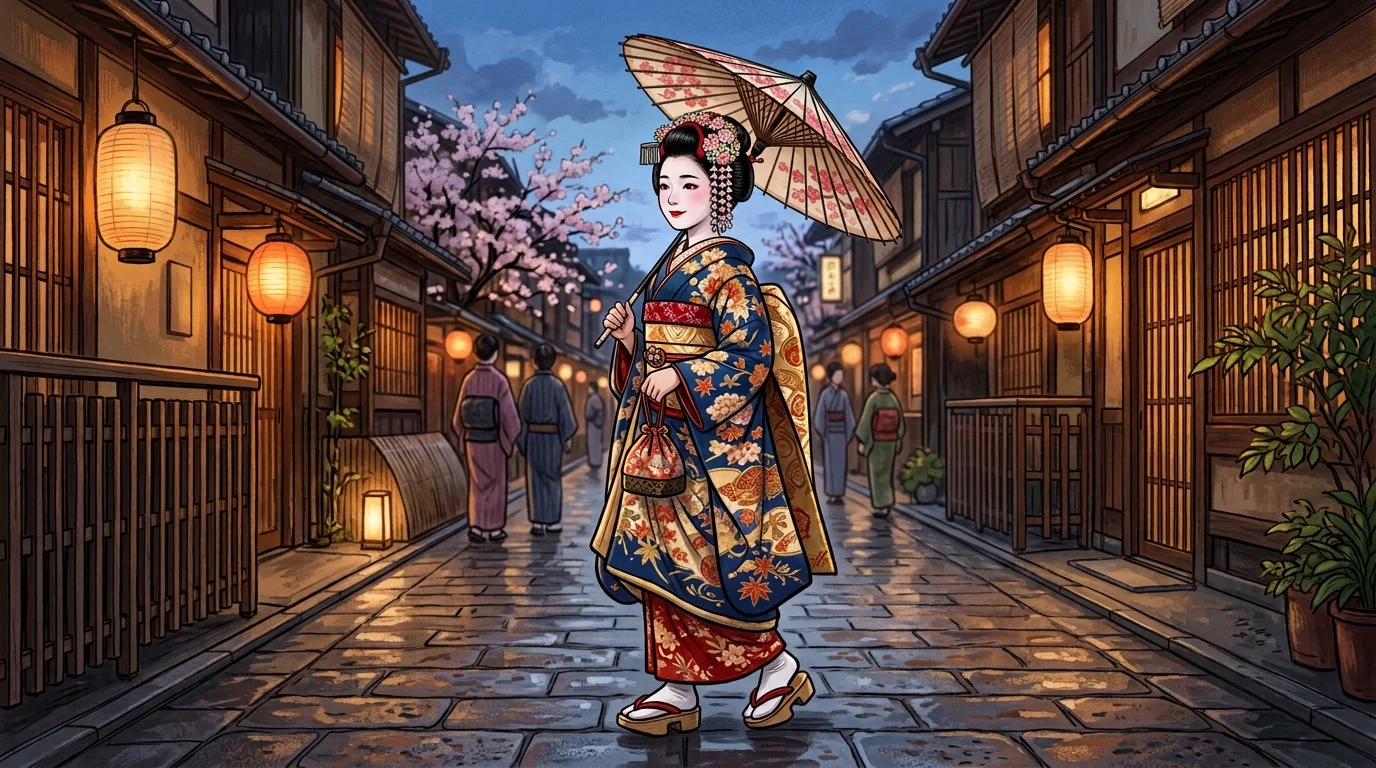
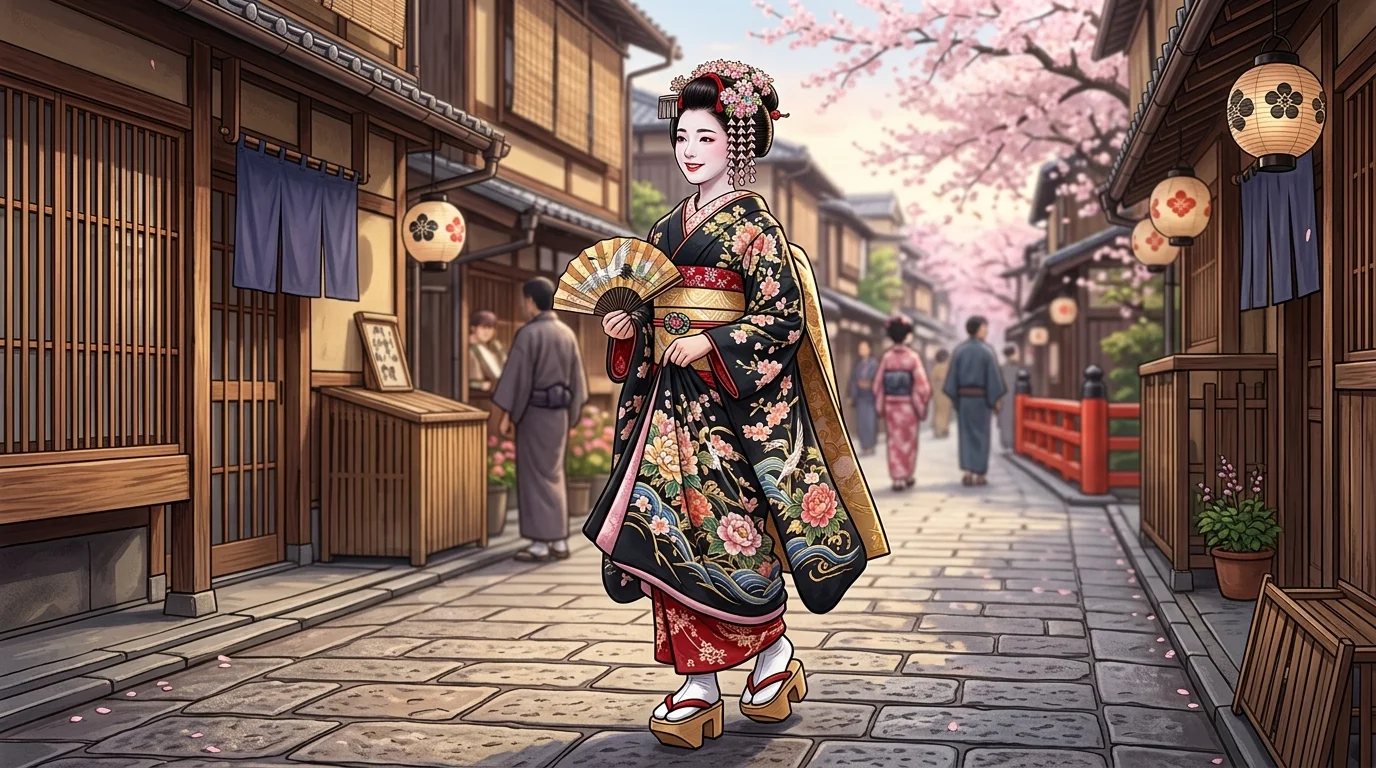
Their appearance is also distinctive, often including elaborate hairstyles, seasonal ornaments, traditional kimono, and formal makeup.
Maiko Meaning in Japanese
In Japanese, maiko is written as 舞妓.
The characters provide an important clue to the traditional meaning:
舞 = dance
妓 = female entertainer/performer
The word therefore refers to a young apprentice who is training in traditional performing arts.
Maiko in Kyoto
The term maiko is particularly associated with Kyoto’s traditional entertainment districts, where apprentices train under the local geiko tradition.
Maiko are generally younger than geiko and are still completing their professional training.
Maiko Meaning in Chinese
In Chinese characters, 舞妓 can be read differently from Japanese.
The individual characters have meanings related to:
- 舞 = dance
- 妓 = female entertainer or performer
However, 舞妓 is primarily a Japanese cultural term when discussing maiko in Kyoto.
Chinese-language explanations may therefore retain the Japanese cultural term rather than treating maiko as an ordinary Chinese personal name or profession.
It is important not to assume that the Chinese reading of the characters is the pronunciation of the Japanese word.
Maiko vs Geisha
The biggest difference is training status and age, especially in the Kyoto tradition.
A maiko is an apprentice, while a geiko/geisha is a fully trained professional.
| Feature | Maiko | Geiko/Geisha |
|---|---|---|
| Status | Apprentice | Professional |
| Training | Still learning | Fully trained |
| Typical association | Kyoto | Kyoto and other parts of Japan |
| Age | Generally younger | Generally older/more experienced |
| Clothing | Often colorful and elaborate | Usually more understated |
| Hairstyle | Traditionally wears elaborate styled natural hair | Often uses wigs or different formal hairstyles |
| Accessories | Often elaborate seasonal hair ornaments | Generally more restrained |
| Makeup | Often distinctive traditional makeup | Can be more restrained depending on occasion |
| Main role | Training and performing | Professional performing and hospitality |
Age alone does not define the distinction. The professional training stage is more important.
Do Maiko Become Geisha?
Traditionally, a maiko who completes her apprenticeship may become a geiko in Kyoto.
The transition represents advancement from apprentice status to professional status.
Not every apprentice necessarily follows the same path, and individual circumstances can vary.
Maiko vs Geisha vs Oiran
These three terms are sometimes confused because all are connected with historical Japanese entertainment culture, but they describe different roles and historical institutions.
| Feature | Maiko | Geiko/Geisha | Oiran |
|---|---|---|---|
| Basic role | Apprentice traditional entertainer | Professional traditional entertainer | High-ranking courtesan |
| Historical context | Traditional arts apprenticeship | Traditional arts and hospitality | Edo-period pleasure districts |
| Main association | Kyoto | Kyoto/Japan | Historical Edo Japan |
| Training | Apprentice | Professional | Trained in arts and etiquette |
| Sexual role | Not inherently sexual | Not inherently sexual | Courtesan institution included sexual relationships |
| Modern status | Exists today in Kyoto | Exists today | Historical tradition |
| Famous visual features | Elaborate kimono and hair ornaments | Formal kimono and refined appearance | Highly elaborate historical dress |
Maiko vs Oiran
A maiko should not be described as a modern courtesan.
An oiran belonged to a historical system of licensed pleasure districts and occupied a high social rank within that system. Oiran were trained in various arts and cultural accomplishments, but their role was fundamentally different from that of maiko.
Geisha vs Oiran
Geisha and oiran also developed within different historical traditions.
A geisha’s professional role centered on entertainment, performance, music, dance, conversation, and hospitality.
An oiran was a courtesan, and sexual relationships were part of the historical institution in which oiran worked.
This distinction is important because popular media sometimes incorrectly portrays geisha as equivalent to courtesans.
Makanai Meaning
Makanai (まかない / 賄い) is a Japanese word that can mean food provided to employees, staff meals, or the preparation/provision of meals for workers.
The exact meaning depends on context.
In traditional Japanese establishments, makanai can refer to meals prepared for staff rather than customers.
Makanai in the Maiko and Geiko World
In discussions about Kyoto’s maiko and geiko communities, makanai may refer to the people responsible for household or practical support, or to staff meals depending on the context.
This distinction matters because makanai does not simply mean “geisha assistant.”
The Japanese word 賄い has a broader meaning connected with providing or managing food and household needs.
Makanai Meaning in Japanese
賄い (makanai) can refer to:
- Staff meals
- Food prepared for employees
- Provisioning or household arrangements
- Practical support, depending on context
The meaning should therefore be determined from the Japanese sentence in which it appears.
Maiko Salary
There is no single universal maiko salary.
The financial arrangements of maiko and traditional geiko households are different from an ordinary modern salaried job. Apprentices may receive housing, meals, clothing, training, and other forms of support depending on the okiya (traditional geiko/maiko household) and the arrangements under which they train.
For this reason, giving one fixed annual “maiko salary” can be misleading.
Do Maiko Get Paid?
Maiko may receive financial allowances or other support, but their circumstances are not necessarily comparable to a conventional employee receiving a standard monthly salary.
Training expenses can be substantial because traditional clothing, accessories, lessons, accommodation, and other costs are involved.
The exact financial arrangement can vary considerably.
Do Geiko Make More Than Maiko?
Generally, a fully established geiko has a different professional and financial position from an apprentice maiko.
A geiko has completed training and can perform professionally, while a maiko remains in an apprenticeship stage.
However, exact income depends on bookings, performances, local practice, household arrangements, and other factors, so there is no single salary figure that applies to every geiko or maiko.
Maiko Training
Becoming a maiko traditionally involves intensive training in Japanese arts and social etiquette.
Training can include:
- Traditional Japanese dance
- Shamisen
- Singing
- Tea culture
- Conversation
- Formal manners
- Hospitality
- Seasonal customs
- Traditional performance etiquette
The goal is not simply to learn how to dress or perform. A maiko is developing the cultural, artistic, and social skills needed for professional life as a geiko.
Maiko Clothing and Appearance
Maiko are particularly recognizable because of their elaborate traditional appearance.
Common features can include:
- Colorful kimono
- Long sleeves associated with furisode-style clothing
- Obi
- Traditional footwear
- Elaborate hairstyles
- Seasonal hair ornaments
- Traditional makeup
Their appearance is part of a broader system of seasonal aesthetics and formal presentation.
Why Do Maiko Wear Elaborate Hairstyles?
Traditional maiko hairstyles and hair ornaments are part of their distinctive apprentice appearance.
Hair ornaments can also reflect seasonality, with different decorative elements appearing at different times of the year.
This is one reason photographs of maiko can look particularly colorful and elaborate.
Are Maiko and Geisha the Same?
They are related but not exactly the same status.
In Kyoto terminology:
Maiko = apprentice
Geiko = fully trained professional
The word geisha is the broader term familiar outside Kyoto and is often used as an equivalent of geiko.
Are Geiko and Geisha Different?
In most practical discussions, geiko and geisha describe the same general profession, but the terminology is regional.
Kyoto traditionally uses geiko, while geisha is more widespread elsewhere in Japan.
Therefore, saying that geiko and geisha are completely different professions would be misleading.
Are Maiko and Geisha Prostitutes?
No.
A maiko is an apprentice traditional entertainer, and a geisha/geiko is a professional entertainer trained in traditional Japanese arts and hospitality.
They should not automatically be equated with prostitution or courtesan culture.
The confusion partly comes from the historical overlap of different entertainment districts and occupations, as well as Western portrayals that have sometimes simplified or distorted the tradition.
Maiko, Geiko and Oiran: Simple Explanation
The easiest way to remember the distinction is:
Maiko → apprentice
Geiko/Geisha → professional traditional entertainer
Oiran → historical high-ranking courtesan
These categories belong to different historical and cultural contexts, even though their clothing, arts, and historical associations can sometimes overlap in popular representations.
Frequently Asked Questions About Maiko and Geiko
What does geiko mean?
Geiko is the Kyoto term for a professional traditional Japanese entertainer trained in arts such as dance, music, singing, conversation, and hospitality.
What does maiko mean in English?
Maiko generally means a young apprentice geiko in Kyoto. The characters 舞妓 can be interpreted broadly as relating to a dancing or performing apprentice.
What is the difference between maiko and geisha?
A maiko is traditionally an apprentice, while a geiko/geisha is a fully trained professional. In Kyoto, geiko is the preferred local term.
What does makanai mean?
Makanai (賄い) can mean staff meals or food provided to workers. Depending on context, it can also refer to provisioning or practical household support.
How much does a maiko earn?
There is no universal maiko salary. Apprentices may receive allowances and support such as accommodation, meals, clothing, and training, depending on their okiya and circumstances.
Is a maiko a geisha?
A maiko is an apprentice on the path toward becoming a geiko in Kyoto. Therefore, the terms describe different stages rather than identical statuses.
What is the difference between maiko, geisha, and oiran?
A maiko is an apprentice traditional entertainer, a geiko/geisha is a professional traditional entertainer, and an oiran was a high-ranking historical courtesan.
What does maiko mean in Japanese?
Maiko is written 舞妓 and refers to a young apprentice in Kyoto’s traditional geiko entertainment culture.
What does maiko mean in Chinese?
The characters 舞妓 can be explained through their individual meanings as relating to dance and a female performer, but maiko is fundamentally a Japanese cultural term in this context.
Where are maiko found?
Maiko are especially associated with Kyoto, where they train within the city’s traditional geiko entertainment districts.
Do maiko wear wigs?
Traditional maiko hairstyles are distinctive and are generally associated with styling the apprentice’s own hair. Professional geiko may use wigs, known as katsura, depending on the situation and tradition.
Can foreigners become maiko?
Traditional maiko training is highly selective and tied to specific cultural institutions and households. Modern opportunities for non-Japanese participants can vary, so there is no simple general rule that applies to every okiya.
What does geisha mean?
Geisha refers to a professional Japanese entertainer trained in traditional arts, music, dance, conversation, and hospitality. In Kyoto, geiko is the traditional local term.

What Does “Maiko” Mean?
Quick Definition
Maiko is a Japanese word meaning “dancing child” or “dance girl.” It refers to a young woman training to become a geisha, primarily in Kyoto.
Literal Meaning
The word maiko (舞妓) consists of two Japanese characters:
- Mai (舞) – Dance
- Ko (妓) – Performer or entertainer
Together, the term means “dancing performer” or “dancing child.”
What It Usually Means
Today, maiko commonly refers to:
- An apprentice geisha.
- A student of traditional Japanese arts.
- A cultural performer in Kyoto.
- A young entertainer undergoing formal training.
Maiko Meaning in Japanese Culture
In traditional Japanese culture, maiko preserve artistic traditions that have been passed down for generations.
Their training includes:
- Classical Japanese dance.
- Playing traditional musical instruments.
- Singing.
- Tea ceremony.
- Conversation and etiquette.
- Cultural hospitality.
Rather than simply entertaining guests, maiko help preserve important aspects of Japan’s artistic heritage.
Origin and History of Maiko
The maiko tradition developed in Kyoto, Japan, where geisha culture has flourished for centuries.
Young women who wished to become geisha traditionally began as apprentices, learning under experienced professionals. During this period, they practiced dance, music, manners, and other traditional arts while gradually gaining experience at social gatherings.
Although customs have evolved over time, the apprenticeship remains an important part of Kyoto’s geisha tradition.
How Does Someone Become a Maiko?
Becoming a maiko requires years of dedication and training.
Typical responsibilities include:
- Studying traditional dances.
- Learning musical instruments such as the shamisen.
- Practicing tea ceremony.
- Developing conversation skills.
- Learning formal etiquette.
- Wearing traditional clothing correctly.
After completing their apprenticeship, a maiko may become a geisha (called geiko in Kyoto).
Maiko vs. Geisha
| Feature | Maiko | Geisha (Geiko in Kyoto) |
|---|---|---|
| Experience | Apprentice | Fully trained professional |
| Age | Usually younger | Usually older |
| Kimono | Bright, colorful designs | More understated styles |
| Hairstyle | Natural, elaborate hairstyles | Often wears traditional wigs |
| Obi (Sash) | Long, flowing obi | Shorter, simpler obi |
| Training | Still learning | Completed apprenticeship |
Appearance of a Maiko
Maiko are known for their distinctive appearance.
They often wear:
- Colorful silk kimonos.
- Long decorative obi.
- Traditional wooden sandals (okobo).
- Ornate hair ornaments (kanzashi).
- White face makeup for performances.
- Elegant hairstyles using their natural hair.
These features help distinguish them from fully qualified geisha.
How People Use the Word “Maiko”
You’ll often hear the word in discussions about:
- Japanese culture.
- Kyoto tourism.
- Traditional performing arts.
- Cultural festivals.
- Historical documentaries.
Examples include:
- “We saw a maiko walking through Kyoto.”
- “She is training as a maiko.”
- “The museum has an exhibit about maiko and geisha.”
Real Examples of Maiko in Conversations
Example 1
Person A: What is a maiko?
Person B: She’s an apprentice geisha learning traditional Japanese arts.
Meaning: Basic definition.
Example 2
Person A: Is every maiko a geisha?
Person B: Not yet. A maiko becomes a geisha after completing her training.
Meaning: Apprentice stage.
Example 3
Person A: Why is her kimono so colorful?
Person B: Maiko usually wear brighter clothing than geisha.
Meaning: Traditional attire.
Example 4
Person A: Where can you see maiko?
Person B: They’re most commonly associated with Kyoto.
Meaning: Cultural location.
Example 5
Person A: What does maiko literally mean?
Person B: It means “dancing child” or “dance girl.”
Meaning: Word origin.
Example 6
Person A: How long does training take?
Person B: It usually takes several years before becoming a geisha.
Meaning: Apprenticeship.
Example 7
Person A: Do maiko perform dances?
Person B: Yes, dance is a major part of their training.
Meaning: Traditional art.
Example 8
Person A: Are maiko still around today?
Person B: Yes, especially in Kyoto, where the tradition continues.
Meaning: Modern relevance.
Common Mistakes and Misunderstandings
People often assume:
- Maiko and geisha are the same.
- Every woman in a kimono is a maiko.
- Maiko only perform dances.
In reality:
- A maiko is an apprentice, while a geisha is fully trained.
- Traditional kimono are worn by many people for different occasions.
- Maiko also study music, etiquette, conversation, and tea ceremony.
Similar Terms
| Term | Meaning | Difference |
|---|---|---|
| Maiko | Apprentice geisha | Still in training |
| Geisha | Traditional entertainer | Fully trained professional |
| Geiko | Kyoto term for geisha | Regional name |
| Oiran | Historical courtesan | Different historical role |
| Kimono | Traditional Japanese garment | Clothing, not a profession |
| Kanzashi | Hair ornament | Accessory worn by maiko and others |
| Shamisen | Three-stringed instrument | Musical instrument used in training |
| Tea Ceremony | Traditional cultural practice | One of the arts maiko learn |
Is “Maiko” Positive, Negative, or Neutral?
Maiko is a positive and respectful cultural term. It represents dedication, artistic training, discipline, and the preservation of traditional Japanese culture.
Should You Use the Word “Maiko”?
Use It When
- Referring to an apprentice geisha.
- Discussing Kyoto traditions.
- Talking about Japanese performing arts.
- Describing traditional cultural practices accurately.
Avoid It When
- Referring to all women wearing kimonos.
- Using it as a synonym for geisha without recognizing the distinction.
Related posts:
 Apocryphal Meaning: Definition, Origin, Examples & How to Use It (2026)
 Best Nine Line Meaning: Definition, Origin, Uses, Examples & What It Represents (2026)
 Complete Humanism Meaning Guide Powerful Definition, History, Beliefs & Examples (2026)
 Best Lute Meaning Slang Explained Definition, Text Meaning, Origin, Examples & Uses (2026)