
What Does YIMBY Meaning?
Quick Definition
YIMBY means “Yes In My Backyard.” It describes people who support building new housing, infrastructure, or businesses in their own communities.
Full Form
YIMBY = Yes In My Backyard
What It Usually Means
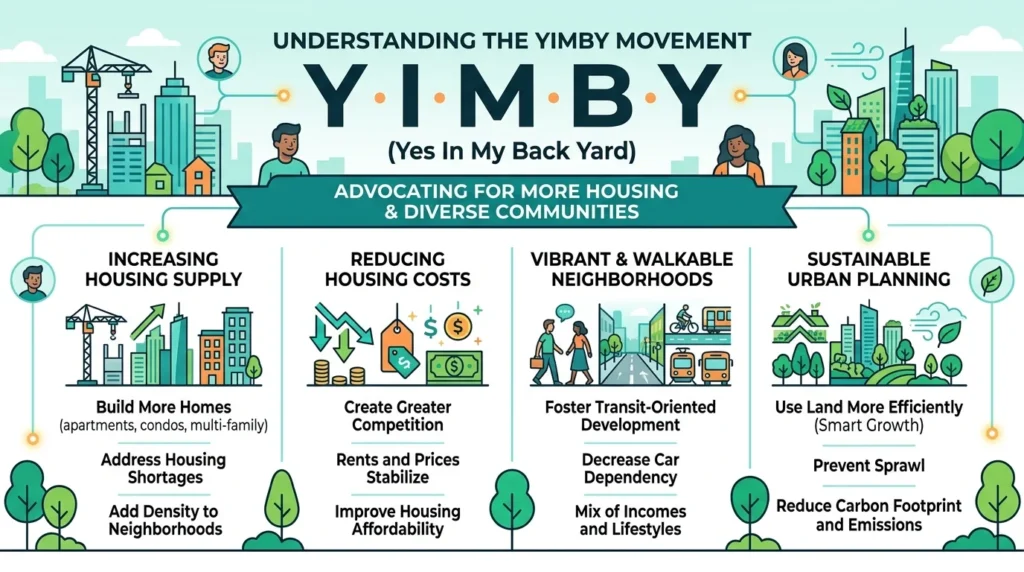
A YIMBY typically supports:
- New housing developments
- Apartment buildings
- Affordable housing
- Public transportation projects
- Mixed-use developments
- Smart urban growth
What Tone Does It Convey?
The term is generally:
- Positive among supporters
- Neutral in journalism
- Sometimes debated in political discussions
Origin and History of YIMBY
The term YIMBY emerged in the early 2010s as a response to NIMBY (“Not In My Backyard”).
As housing costs increased in many cities, groups advocating for more housing construction adopted the term YIMBY to express support for development rather than opposition.
Today, YIMBY has become a widely recognized movement in discussions about housing policy, zoning laws, and city planning.
How People Actually Use YIMBY
You’ll often hear YIMBY used in discussions about:
- Housing shortages
- Apartment construction
- City planning
- Affordable housing
- Zoning reform
- Public transportation
For example: “Many YIMBY groups support building more homes near public transit.”
Or: “She considers herself a YIMBY because she believes more housing helps reduce prices.”
YIMBY vs. NIMBY
| Term | Full Form | Meaning |
|---|---|---|
| YIMBY | Yes In My Backyard | Supports new local development |
| NIMBY | Not In My Backyard | Opposes nearby development |
The biggest difference is that YIMBY supporters generally encourage construction projects, while NIMBY opponents may resist developments they believe could affect their neighborhood.
Real Examples of YIMBY in Sentences
Example 1
“Our city has several YIMBY organizations promoting affordable housing.”
Meaning: Groups that support building more homes.
Example 2
“He’s a YIMBY who welcomes new apartment buildings.”
Meaning: He supports local development.
Example 3
“The debate between YIMBY and NIMBY groups lasted for hours.”
Meaning: Two groups disagreed about a proposed project.
Example 4
“Many young professionals identify with the YIMBY movement.”
Meaning: They generally support increasing housing construction.
Example 5
“The mayor received support from local YIMBY advocates.”
Meaning: Supporters of new development backed the proposal.
Common Mistakes and Misunderstandings
Mistake 1: Thinking YIMBY Supports Every Development
Not necessarily. Many YIMBY supporters favor projects that increase housing supply and improve communities, but they may still oppose developments they consider harmful.
Mistake 2: Confusing YIMBY with NIMBY
These terms represent opposite viewpoints regarding local development.
Mistake 3: Assuming YIMBY Is Only About Housing
Although housing is the primary focus, YIMBY discussions may also involve:
- Public transportation
- Parks
- Schools
- Infrastructure
- Commercial development
Mistake 4: Believing YIMBY Is a Political Party
YIMBY is a movement or philosophy, not a political party.
Similar Terms and Related Acronyms
| Term | Meaning | Difference |
| YIMBY | Yes In My Backyard | Supports local development |
| NIMBY | Not In My Backyard | Opposes nearby development |
| BYOB | Bring Your Own Bottle | Social abbreviation, unrelated |
| HOA | Homeowners Association | Community organization |
| Zoning | Land-use regulation | Governs development |
| Urban Planning | City development process | Broader field |
| Affordable Housing | Lower-cost housing | Common YIMBY goal |
| Mixed-Use Development | Residential and commercial buildings together | Type of development |
| Infrastructure | Public facilities and services | Includes roads and utilities |
| Transit-Oriented Development | Development near public transportation | Often supported by YIMBY groups |
Is YIMBY Positive, Negative, or Neutral?
Generally Neutral
YIMBY is primarily a descriptive term for a person’s views on development.
Positive Meaning
Supporters often associate YIMBY with:
- More housing
- Better affordability
- Sustainable growth
- Stronger communities
Critical Views
Some critics argue that not every development benefits existing neighborhoods. Because of this, YIMBY policies are sometimes debated in public planning discussions.
Related posts:
 Best Harakiri Meaning Definition, History, Cultural Significance & Modern Usage (2026)
 Best Concentration Meaning: Definition, Examples, Uses, and Types (2026)
 Wyatt Name Meaning: Origin, History, Personality & Popularity (2026)
 Tiger Eye Meaning: Symbolism, Spiritual Significance, Benefits & Uses (2026)