
What Does Cap Meaning in Slang?
Quick Definition
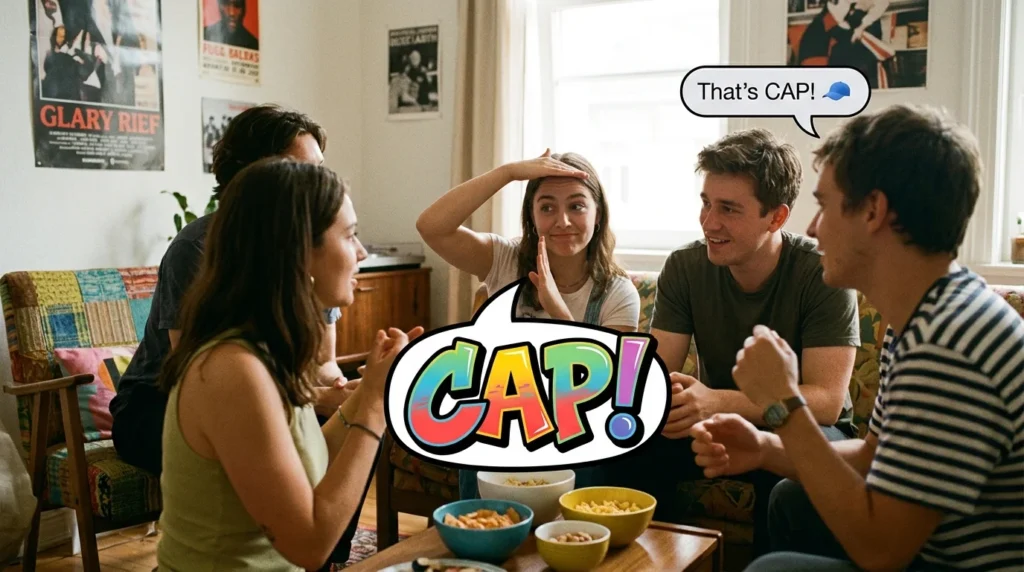
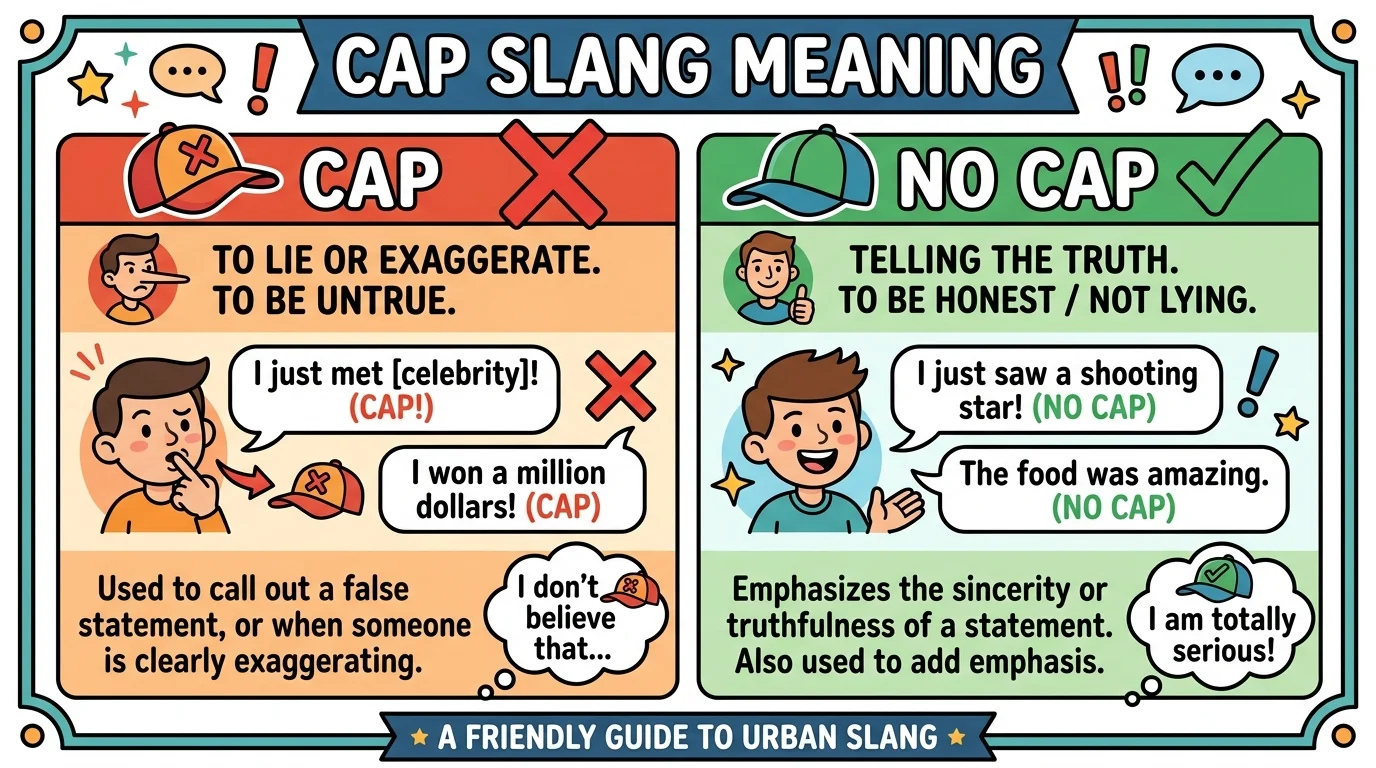
In slang, cap means a lie, false statement, or exaggeration.
Example: “You said you ran 20 miles in an hour? That’s cap.”
Meaning: “I don’t believe you. You’re exaggerating.”
What Does “Cap” Mean in Text Messages?
In texting and online conversations, cap is usually used to challenge whether something is true.
Common phrases include:
- That’s cap = That’s a lie.
- You’re capping = You’re lying or exaggerating.
- Stop the cap = Stop lying.
- No cap = Honestly / I’m telling the truth.
What Does “No Cap” Mean?
No cap is the opposite of cap.
It means:
- I’m being honest.
- I’m serious.
- This is true.
- I’m not exaggerating.
Examples: “No cap, this is the best pizza I’ve ever had.”
Meaning: “Seriously, this is the best pizza I’ve ever had.”
Origin and History of “Cap” Slang
The slang use of cap became popular through hip-hop culture and later spread through social media platforms like TikTok, Twitter, and Instagram.
The phrase is often connected to the idea of “capping” meaning pretending, exaggerating, or lying. The exact origin is debated, but the expression became widely recognized through music and online communities.
Today, cap is especially common among:
- Gen Z users
- Gamers
- TikTok communities
- Social media users
- Online friend groups
How People Actually Use “Cap”
Most people use cap casually when they think someone is not being truthful.
Calling Out a Lie
Example: “You got 100% on that impossible test? That’s cap.”
Meaning: “I think you’re lying.”
Expressing Surprise
Sometimes people use it jokingly when something sounds unbelievable.
Example: “No cap, that movie was amazing.”
Meaning: “Honestly, that movie was really good.”
In Gaming
Gamers may use cap when someone makes an unbelievable claim.
Example: “You said you won against the top player? Cap.”
Meaning: “I don’t believe that happened.”
Real Examples of “Cap” in Conversations
Example 1
Person A: I can finish this entire pizza by myself.
Person B: That’s cap.
Meaning: Person B thinks Person A is exaggerating.
Example 2
Person A: No cap, this new game is incredible.
Person B: I might have to try it.
Meaning: Person A is saying they are being honest.
Example 3
Person A: I haven’t slept for three days.
Person B: Bro, stop capping.
Meaning: Person B thinks the claim is probably false.
Example 4
Person A: This is the best song ever made, no cap.
Person B: I actually agree.
Meaning: The speaker genuinely believes their opinion.
Example 5
Person A: I won the match without trying.
Person B: That’s straight cap.
Meaning: Person B believes the person is exaggerating.
Example 6
Person A: No cap, that restaurant has the best burgers.
Person B: I’ll check it out.
Meaning: The speaker is giving an honest opinion.
Cap Meaning on Different Platforms
TikTok
On TikTok, cap is commonly used in comments to call out exaggerated videos or unbelievable claims.
Example: “This hack actually works? No cap?”
Snapchat
Friends may use cap casually in snaps or chats.
Example: “You’re capping 😂”
Meaning: “You’re joking or lying.”
Users often comment:
- “No cap 🔥”
- “That’s cap”
to show agreement or disbelief.
Discord
Gamers commonly use cap during conversations about skills, achievements, or game results.
The phrase appears in discussions when users question whether a claim is accurate.
Common Mistakes and Misunderstandings
Mistake 1: Thinking Cap Always Means a Hat
In standard English, cap means a type of hat. In slang, it usually means a lie or exaggeration.
The meaning depends on the context.
Mistake 2: Using “No Cap” Incorrectly
“No cap” should be used when emphasizing honesty.
Incorrect: “No cap, I might be lying.”
Correct: “No cap, I really enjoyed that movie.”
Mistake 3: Thinking Cap Is Always Serious
Many people use “cap” jokingly with friends.
Example: “You finished that whole cake? Cap 😂”
Mistake 4: Assuming Everyone Understands Slang
Older generations or people outside online communities may not understand slang terms like cap.
Similar Slang Terms and Related Expressions
| Slang | Meaning | Difference |
|---|---|---|
| Cap | A lie or exaggeration | Main slang term |
| No cap | Telling the truth | Opposite of cap |
| Capping | Lying or exaggerating | Action form of cap |
| Sus | Suspicious or questionable | Used when something seems strange |
| Fake | Not real or genuine | More general |
| Fronting | Pretending or acting differently | Often about appearance |
| BS | Nonsense or dishonesty | Stronger expression |
| Bet | Agreement or confidence | Not related to lying |
| Facts | Showing agreement or truth | Opposite feeling of cap |
| For real | Seriously or honestly | Similar to no cap |
Is “Cap” Positive, Negative, or Neutral?
The meaning depends on how it is used.
Negative Use
When calling someone dishonest: “You’re capping.”
This suggests the person is lying.
Playful Use
Among friends, it can be a joke: “That’s cap 😂”
Positive Use
“No cap” is usually positive because it emphasizes honesty.
Related posts:
 Best Harakiri Meaning Definition, History, Cultural Significance & Modern Usage (2026)
 Best Concentration Meaning: Definition, Examples, Uses, and Types (2026)
 Apocryphal Meaning: Definition, Origin, Examples & How to Use It (2026)
 Best Variable Meaning in Math: Definition, Types, Examples & How They Work (2026)