
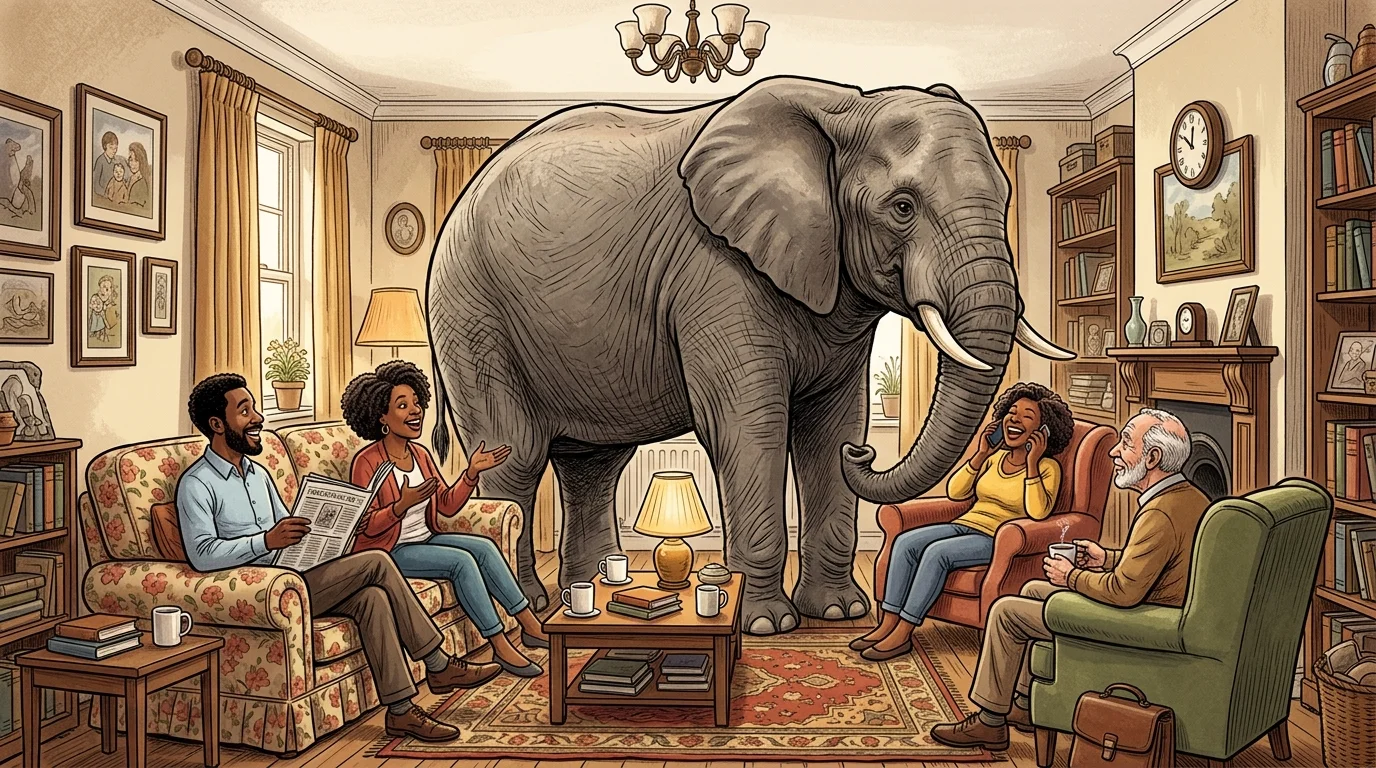
The Elephant in the Room Meaning
“The elephant in the room” is an English idiom describing an obvious, important, or uncomfortable issue that everyone knows about but no one wants to talk about.
The “elephant” is not literal. It represents something so noticeable or significant that it should be impossible to ignore, while “the room” represents the situation or group of people where everyone is deliberately avoiding the subject.
Simple example:
If a family is sitting together after a major argument but everyone talks about the weather instead, the argument may be the elephant in the room.
In simple words:
The elephant in the room = an obvious problem that people are avoiding discussing.
What Does “The Elephant in the Room” Mean?
The expression is usually used when:
- Everyone is aware of a problem.
- The issue is difficult or embarrassing.
- People are uncomfortable discussing it.
- Someone is deliberately changing the subject.
- The issue affects everyone involved.
- Avoiding the issue makes the situation awkward.
For example:
“Nobody wanted to discuss the company’s financial problems, but they were the elephant in the room.”
This means the financial problems were obvious and important, yet everyone avoided talking about them.
The Elephant in the Room Examples
Example 1: Family
“Everyone was worried about their father’s health, but nobody mentioned it. His illness was the elephant in the room.”
The health problem was obvious, but the family avoided discussing it.
Example 2: Relationship
“They kept talking about their vacation plans, but the fact that they were considering breaking up was the elephant in the room.”
The couple was avoiding an important relationship issue.
Example 3: Workplace
“The company had just lost its biggest client, but nobody mentioned it during the meeting. That was the elephant in the room.”
Everyone knew about the problem, but no one addressed it.
Example 4: Friendship
“After their argument, they acted normally, but the argument was still the elephant in the room.”
The disagreement remained unresolved even though they were pretending everything was fine.
Example 5: School
“The students knew the exam results were disappointing, but the teacher didn’t bring them up. The results were the elephant in the room.”
The issue was obvious but deliberately avoided.
“Address the Elephant in the Room” Meaning
“Address the elephant in the room” means to openly discuss an obvious or uncomfortable issue that everyone has been avoiding.
For example:
“We need to address the elephant in the room before we make any further decisions.”
This means the group needs to talk honestly about the major unresolved issue before moving forward.
Other expressions with a similar meaning include:
- Face the issue
- Confront the problem
- Talk about the obvious problem
- Bring up the difficult subject
- Deal with the uncomfortable truth
- Stop avoiding the issue
How to Address the Elephant in the Room
You can address an uncomfortable issue respectfully by:
- Clearly identifying the issue.
- Avoiding accusations.
- Explaining why it needs to be discussed.
- Giving everyone an opportunity to respond.
- Focusing on solutions rather than blame.
For example:
“I think there is something important we haven’t discussed. Can we talk about what happened yesterday?”

The Elephant in the Room in a Relationship
In a relationship, the elephant in the room is usually an important issue that both partners recognize but avoid discussing.
It could involve:
- Trust problems
- Frequent arguments
- Financial difficulties
- Different expectations
- Lack of communication
- Infidelity
- Commitment concerns
- A possible breakup
- Family disagreements
- Emotional distance
For example:
“Their relationship seemed normal on the outside, but their lack of trust was the elephant in the room.”
The expression does not automatically mean that a relationship is ending. It simply means that an important issue is being avoided.
Elephant in the Room Relationship Example
Imagine two partners who have been arguing repeatedly. Both know the relationship has changed, but they keep discussing ordinary daily activities instead.
Someone might say:
“Their future together was the elephant in the room.”
The meaning is that their uncertainty about the relationship was obvious but remained unspoken.
Elephant in the Room Meaning in Chinese
There are several ways to express the idea in Chinese depending on context.
A useful equivalent is:
房间里的大象
Fángjiān lǐ de dàxiàng
This literally means “the elephant in the room.” It is also used as a translated idiom for the English expression.
The underlying meaning can be explained as:
一个明显存在却被大家刻意回避的问题
This means:
“An obvious problem that everyone deliberately avoids discussing.”
Another Chinese expression that can sometimes convey a similar idea is:
视而不见
shì ér bù jiàn
It literally means “to look but not see” and describes deliberately ignoring something obvious. However, it is not an exact equivalent of “the elephant in the room.”
Elephant in the Room Meaning in Arabic
A literal translation is:
الفيل في الغرفة
al-fīl fī al-ghurfa
This means “the elephant in the room.”
To explain the idiomatic meaning more naturally in Arabic, you could say:
مشكلة واضحة يتجنب الجميع الحديث عنها
This means:
“An obvious problem that everyone avoids talking about.”
Another natural explanation is:
موضوع واضح وحساس يتجاهله الجميع
Meaning:
“An obvious and sensitive subject that everyone ignores.”
Because the English expression is an idiom, a literal translation may not always communicate its full meaning without explanation.
Elephant in the Room Meaning in French
A common French equivalent is:
L’éléphant dans la pièce
This literally means “the elephant in the room.”
It can describe an obvious issue that people avoid discussing.
For example:
“Il faut parler de l’éléphant dans la pièce.”
This can be understood as:
“We need to talk about the obvious issue everyone is avoiding.”
French may also use expressions such as “un sujet tabou” when the focus is specifically on a taboo or difficult subject, although that is not an exact equivalent in every situation.
White Elephant in the Room Meaning
“White elephant” and “the elephant in the room” are different expressions.
Elephant in the Room
Means:
An obvious issue that people avoid discussing.
White Elephant
A white elephant generally refers to something that is expensive, troublesome, or difficult to maintain but has little practical value.
For example:
“The abandoned stadium became a white elephant.”
This means the stadium became an expensive or burdensome asset with little useful purpose.
Therefore, “white elephant in the room” is not simply another standard form of “elephant in the room.” If someone combines the expressions, the exact meaning depends on context.
Elephant in the Room Origin
The expression has a long history, and its exact origin is sometimes described differently.
One frequently cited early use comes from the 19th century and involves the idea of someone being unable to recognize or acknowledge an elephant that is plainly present.
A particularly important early printed example appeared in the 1814 fable “The Pilgrim” by Russian poet Ivan Krylov, in which a man visits a museum and notices small things while failing to notice an elephant.
The modern English expression developed over time from this broader idea: something enormous and obvious can be present while people behave as though it is not there.
The exact modern wording and its development into the familiar English idiom are not necessarily attributable to a single person or event.
Why Is It Called an Elephant in the Room?
The image works because an elephant is extremely large and difficult to ignore.
Imagine an actual elephant standing inside a small room. Everyone would immediately notice it. Yet the expression imagines people behaving as if nothing unusual is happening.
That creates the central metaphor:
Elephant = obvious major issue
Room = the situation or group of people
Ignoring the elephant = avoiding the issue
This is why the idiom is so effective when describing uncomfortable conversations.
Is “Elephant in the Room” Negative?
Usually, the expression has a negative or uncomfortable tone, because it suggests that an important issue is being avoided.
However, the expression itself is not necessarily an insult. It can simply describe a situation in which people are reluctant to discuss something.
For example:
“The election results were the elephant in the room during the meeting.”
The phrase identifies an avoided topic; it does not by itself tell you whether avoiding it was right or wrong.
Elephant in the Room Synonyms
Depending on the context, similar expressions include:
- Obvious problem
- Unspoken issue
- Uncomfortable truth
- Unresolved issue
- Awkward subject
- Difficult topic
- Problem nobody wants to discuss
- Unspoken concern
- Taboo subject
- Avoided issue
These are not always exact synonyms, because “the elephant in the room” specifically emphasizes that the issue is obvious and being deliberately or collectively avoided.
Elephant in the Room vs. Uncomfortable Truth
These expressions are related but slightly different.
Elephant in the room focuses on an issue that people are avoiding discussing.
Uncomfortable truth focuses on a fact that may be difficult or unpleasant to accept.
An uncomfortable truth can become the elephant in the room when everyone knows about it but refuses to discuss it.
Elephant in the Room in a Sentence
Here are additional natural examples:
- “The company’s declining sales were the elephant in the room.”
- “Nobody wanted to mention their disagreement, so it became the elephant in the room.”
- “Let’s address the elephant in the room before continuing the discussion.”
- “Her resignation was the elephant in the room at the meeting.”
- “Everyone knew they were unhappy, but their relationship problems remained the elephant in the room.”
- “The team’s poor performance was the elephant in the room.”
How to Use “The Elephant in the Room” Correctly
The phrase works best when:
- The issue is fairly obvious.
- Multiple people know about it.
- The subject is uncomfortable or sensitive.
- People are avoiding discussing it.
A natural sentence structure is:
“[Issue] is the elephant in the room.”
For example:
“Money is the elephant in the room.”
You can also say:
“Let’s address the elephant in the room.”
or:
“Nobody wants to talk about the elephant in the room.”
Frequently Asked Questions
What does “the elephant in the room” mean?
It means an obvious and important issue that people are avoiding discussing.
What is an example of an elephant in the room?
If two friends have had a serious argument but continue chatting without mentioning it, their unresolved argument is the elephant in the room.
What does “address the elephant in the room” mean?
It means to openly discuss an obvious or uncomfortable issue that everyone has been avoiding.
Is “elephant in the room” an idiom?
Yes. It is a common English idiom used to describe an obvious but unspoken or avoided issue.
What does elephant in the room mean in a relationship?
It refers to a major relationship issue that both partners recognize but avoid discussing, such as trust problems, communication difficulties, or uncertainty about the relationship.
What is the Chinese meaning of elephant in the room?
A literal translation is 房间里的大象 (fángjiān lǐ de dàxiàng). The underlying meaning is an obvious problem that everyone avoids discussing.
What is the Arabic meaning of elephant in the room?
It can be translated literally as الفيل في الغرفة (al-fīl fī al-ghurfa). The idiomatic meaning is مشكلة واضحة يتجنب الجميع الحديث عنها, or “an obvious problem that everyone avoids discussing.”
What is the French meaning of elephant in the room?
A common French translation is l’éléphant dans la pièce, literally meaning “the elephant in the room.”
Is a white elephant the same as an elephant in the room?
No. The elephant in the room is an obvious issue that people avoid discussing, while a white elephant generally refers to something costly or burdensome with little practical value.
Why do people say “elephant in the room”?
The phrase uses the exaggerated image of an elephant standing inside a room. Because such an animal would be impossible to overlook, it represents an issue that is equally obvious but being ignored.

What Does “Elephant in the Room” Mean?
Quick Definition
Elephant in the room means an obvious fact, issue, or problem that people are aware of but choose not to discuss.
The “elephant” represents something large and noticeable, while the “room” represents the situation where everyone is present.
The idea is simple:
- Everyone sees the issue.
- Everyone knows it exists.
- Nobody wants to talk about it.
What Does Elephant in the Room Mean in Conversations?
In conversations, this phrase points to an uncomfortable subject that people avoid mentioning.
Examples:
- A couple avoiding discussion about relationship problems
- Employees ignoring a major workplace issue
- Friends avoiding a disagreement
- Family members avoiding a sensitive topic
When someone says:
“We need to address the elephant in the room.”
They mean:
“We need to talk about the obvious issue everyone is avoiding.”
What Tone Does Elephant in the Room Convey?
The phrase can have different tones depending on the situation.
Serious:
- Discussing major problems or conflicts
Humorous:
- Pointing out an awkward situation in a funny way
Direct:
- Encouraging people to stop avoiding an issue
Professional:
- Used in meetings to address hidden concerns
What Does Elephant in the Room Mean in Different Contexts?
Elephant in the Room Meaning at Work
In workplaces, the phrase usually refers to problems employees or managers avoid discussing.
Examples:
- Poor company performance
- Leadership problems
- Employee dissatisfaction
- Budget cuts
- A failing project
Example:
“The elephant in the room is that the deadline is impossible to meet.”
Meaning:
Everyone knows the deadline is unrealistic, but nobody has discussed it.
Elephant in the Room Meaning in Relationships
In relationships, the phrase often describes emotional issues people avoid.
Examples:
- Lack of communication
- Trust problems
- Unresolved arguments
- Changing feelings
Example:
“We need to talk about the elephant in the room.”
Meaning:
There is an important relationship issue that needs attention.
Elephant in the Room Meaning in Social Situations
In social settings, the phrase describes awkward topics that people avoid.
Examples:
- Someone behaving differently
- A controversial opinion
- An uncomfortable event
Example:
“Nobody mentioned his sudden resignation. It was the elephant in the room.”
Meaning:
Everyone knew about it but avoided discussing it.
Elephant in the Room Meaning on Social Media
On platforms like TikTok, Instagram, Reddit, and X, people often use this phrase when discussing topics that others ignore.
Examples:
- Online controversies
- Celebrity issues
- Community problems
- Trending debates
Example:
“Let’s talk about the elephant in the room.”
This usually means:
“Let’s discuss the obvious issue everyone has been avoiding.”
Origin and History of Elephant in the Room
The exact origin of the phrase “elephant in the room” is uncertain, but it became popular in the 20th century.
The expression is based on the idea that an elephant is so large that it would be impossible not to notice if one were actually inside a room. The comparison highlights how strange it is for people to ignore something obvious.
The phrase is often connected to the broader idea of avoiding uncomfortable truths. Similar expressions existed before it became popular, but “elephant in the room” became widely used in modern English because of its simple and memorable image.
The first known uses appeared in the early 1900s, and the phrase became especially common in business, psychology, and social discussions.
Because the exact origin is debated, it is best to say that the phrase developed over time rather than crediting it to one specific person.
How People Actually Use Elephant in the Room
Most people use this phrase when they want to acknowledge an uncomfortable topic.
You will often see it in:
- Business meetings
- Interviews
- News discussions
- Relationship conversations
- Online debates
- Personal discussions
When to Use Elephant in the Room
Use the phrase when:
- A major issue is being ignored
- Everyone knows something is wrong
- A difficult conversation needs to happen
- You want to encourage honesty
Examples:
- “The elephant in the room is our declining sales.”
- “Let’s address the elephant in the room before moving forward.”
- “There is an elephant in the room that we need to discuss.”
When Not to Use Elephant in the Room
Avoid using it when:
- The issue is private or sensitive
- Someone may feel attacked
- The problem is not actually obvious
- A direct conversation would be more respectful
For very personal situations, a softer approach may work better.
Real Examples of Elephant in the Room in Conversations
Example 1: Workplace Meeting
Person A:
“Before we discuss new projects, can we talk about the elephant in the room?”
Person B:
“You mean the missed deadlines?”
Meaning:
The team needs to discuss the obvious performance problem.
Example 2: Relationship Conversation
Person A:
“We keep avoiding the elephant in the room.”
Person B:
“You’re right. We need to talk about our communication problems.”
Meaning:
The couple needs to discuss an unresolved issue.
Example 3: Family Discussion
Person A:
“Nobody is mentioning the elephant in the room.”
Person B:
“Everyone knows Grandpa is moving away.”
Meaning:
The family is avoiding an obvious topic.
Example 4: Business Situation
Person A:
“The elephant in the room is our lack of customers.”
Person B:
“We need a new marketing strategy.”
Meaning:
The company has an obvious problem.
Example 5: Social Media Discussion
Person A:
“People are ignoring the elephant in the room.”
Person B:
“Everyone knows what happened.”
Meaning:
People are avoiding a widely known issue.
Example 6: Friendship
Person A:
“Are we going to talk about the elephant in the room?”
Person B:
“Yes, I’m sorry about what happened.”
Meaning:
Friends are addressing an uncomfortable situation.
Example 7: Interview
Person A:
“The elephant in the room is your company’s recent changes.”
Person B:
“That’s something we should discuss.”
Meaning:
The interviewer is bringing up an obvious issue.
Example 8: Politics
Person A:
“The elephant in the room is voter dissatisfaction.”
Person B:
“That issue needs attention.”
Meaning:
A major ignored concern is being discussed.
Example 9: Classroom
Person A:
“The elephant in the room is that nobody finished the assignment.”
Person B:
“We should ask for more time.”
Meaning:
Everyone knows the assignment problem exists.
Example 10: Personal Growth
Person A:
“My biggest elephant in the room is my fear of failure.”
Meaning:
The person recognizes an important issue they usually avoid.
Common Mistakes and Misunderstandings
Thinking It Refers to a Real Elephant
The phrase is not usually about an actual animal.
It is a metaphor describing an ignored issue.
Using It for Small Problems
The phrase usually describes something significant or obvious.
A tiny inconvenience is not normally called an elephant in the room.
Assuming It Is Always Negative
Most examples involve problems, but the phrase simply means an obvious topic people avoid.
The topic could be:
- Serious
- Emotional
- Awkward
- Controversial
Confusing It With “The Bigger Picture”
These phrases have different meanings.
Elephant in the room:
An ignored obvious issue.
Bigger picture:
The overall situation or long-term view.
Similar Phrases and Related Expressions
| Phrase | Meaning | Difference |
|---|---|---|
| Unspoken issue | A topic nobody discusses | Less visual than elephant in the room |
| Awkward topic | An uncomfortable subject | Usually less serious |
| Hidden problem | An issue not easily noticed | Opposite of obvious |
| Open secret | Something widely known but not officially acknowledged | Often involves shared knowledge |
| Avoid the issue | Refuse to discuss something | Focuses on the action |
| Face the facts | Accept reality | Encourages honesty |
| Address the problem | Deal with an issue directly | More professional |
| Skeleton in the closet | Hidden embarrassing secret | Usually private and concealed |
Is Elephant in the Room Positive, Negative, or Neutral?
The phrase is usually neutral, but it often describes negative or uncomfortable situations.
Positive use:
“The elephant in the room is how successful this team has become.”
Negative use:
“The elephant in the room is the company’s financial trouble.”
Neutral use:
“Let’s discuss the elephant in the room before continuing.”
The emotional meaning depends on the topic being avoided.
Should You Use Elephant in the Room?
Use it if:
- You want to discuss an obvious issue.
- You are encouraging honesty.
- You need a simple way to describe an ignored problem.
- The audience understands common expressions.
Avoid it if:
- The situation requires extra sensitivity.
- The person may feel embarrassed.
- A direct and respectful explanation would work better.
Related posts:
 Apocryphal Meaning: Definition, Origin, Examples & How to Use It (2026)
 Best Nine Line Meaning: Definition, Origin, Uses, Examples & What It Represents (2026)
 Complete Humanism Meaning Guide Powerful Definition, History, Beliefs & Examples (2026)
 Best Lute Meaning Slang Explained Definition, Text Meaning, Origin, Examples & Uses (2026)