
What Does “GmbH” Meaning?
Quick Definition
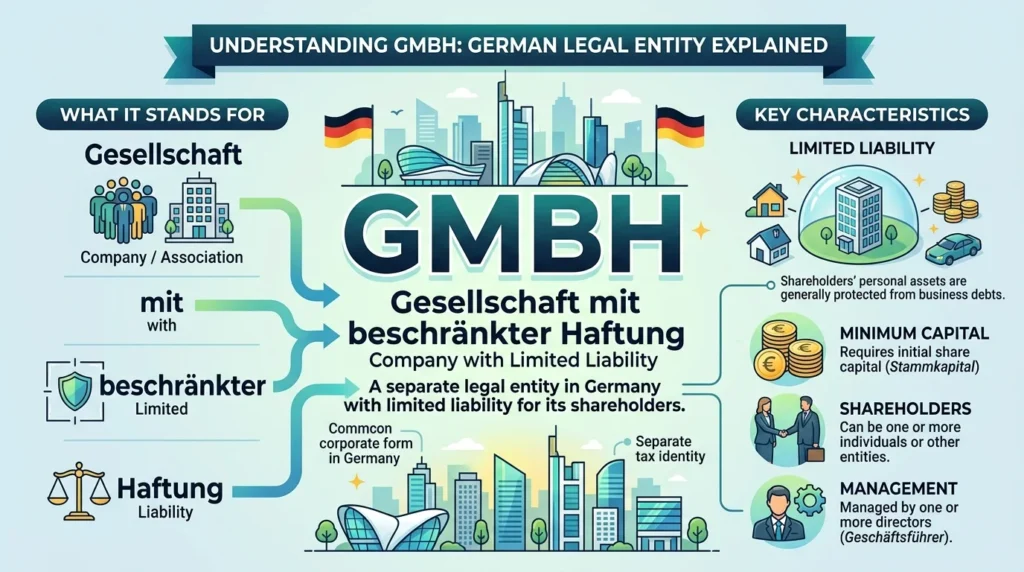
GmbH is a legal company structure that provides limited liability protection to its shareholders.
Full Form
GmbH stands for:
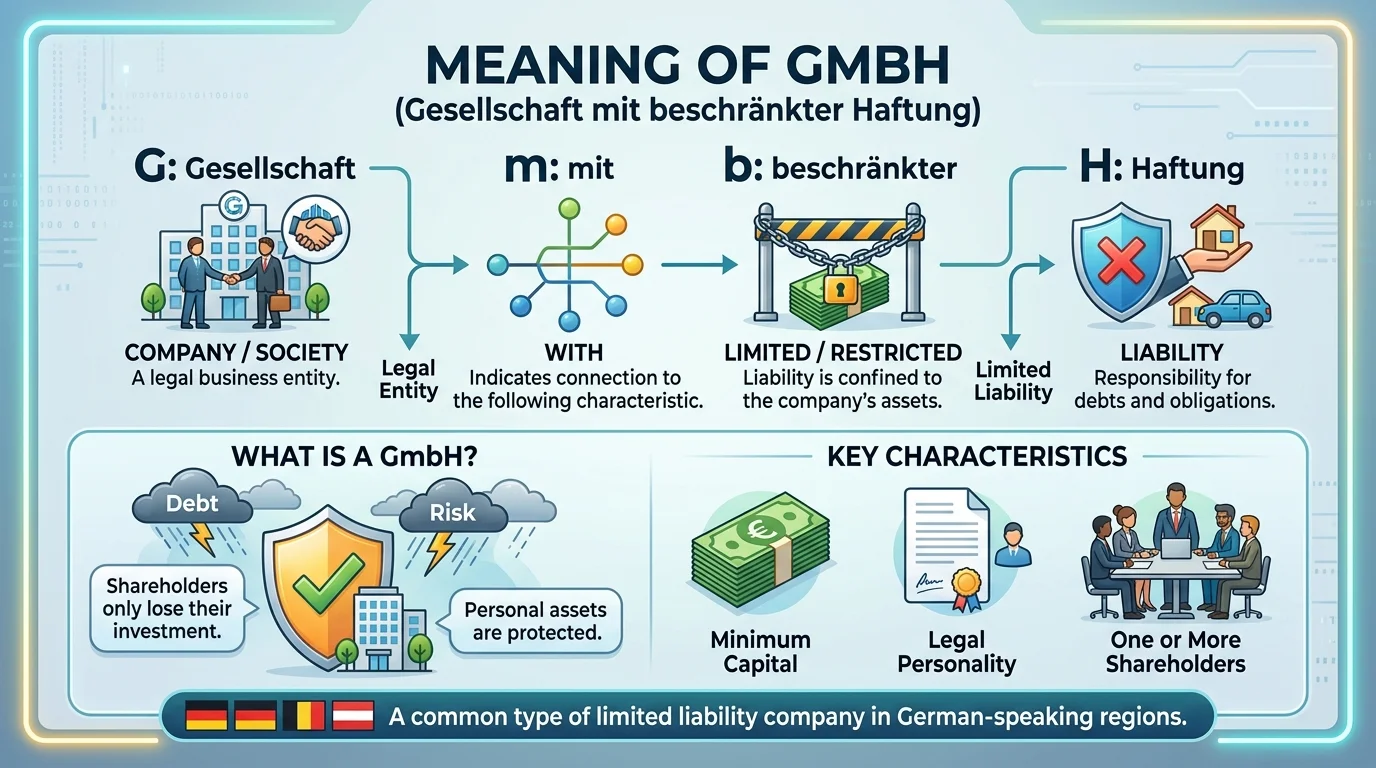
Gesellschaft mit beschränkter Haftung
English translation:
Company with Limited Liability
What It Usually Means
When a business name ends with GmbH, it means:
- The company is a separate legal entity.
- Owners generally aren’t personally responsible for business debts.
- The business is registered under German-speaking corporate law.
What Tone Does It Convey?
GmbH is associated with:
- Professional business operations
- Legal protection
- Corporate credibility
- Limited liability
Where Is GmbH Used?
Germany
Germany is the country most closely associated with the GmbH business structure.
Austria
Many Austrian companies are also organized as GmbHs.
Switzerland
Swiss businesses frequently use GmbH, particularly in German-speaking regions.
Other Countries
Some companies operating internationally retain the GmbH designation because they are registered under German or Austrian law.
How Does a GmbH Work?
A GmbH functions as a separate legal entity from its owners.
Key Features
- Limited liability for shareholders
- Separate legal identity
- Registered company name
- Shareholders own the business through shares
- Managed by one or more directors (managing directors)
Because the company is legally separate, it can:
- Own property
- Enter contracts
- Sue or be sued
- Continue operating even if ownership changes
Advantages of a GmbH
Limited Liability
One of the biggest benefits is that shareholders are generally protected from personal responsibility for the company’s debts beyond their investment.
Professional Image
Many customers and business partners view a GmbH as an established and credible business.
Separate Legal Entity
The company exists independently of its owners.
Business Continuity
Ownership can change without automatically ending the company.
Origin and History of GmbH
The GmbH legal structure was introduced in Germany in 1892 to provide a business form that combined the flexibility of partnerships with the liability protection of corporations.
Since then, it has become one of the most common company structures in German-speaking countries and has influenced similar limited liability business forms around the world.
Examples of GmbH in Company Names
Many companies include GmbH at the end of their legal names.
Examples:
- Example Technology GmbH
- Alpine Engineering GmbH
- Berlin Logistics GmbH
- Green Energy GmbH
- Precision Tools GmbH
The abbreviation simply identifies the company’s legal structure.
GmbH vs. Other Business Structures
| Business Structure | Country | Limited Liability | Similar to GmbH |
|---|---|---|---|
| GmbH | Germany, Austria, Switzerland | Yes | — |
| LLC | United States | Yes | Very similar |
| Ltd | United Kingdom | Yes | Similar concept |
| Inc. | United States | Yes | Corporation structure |
| PLC | United Kingdom | Yes | Public company |
| AG | Germany, Austria, Switzerland | Yes | Public stock corporation |
Common Mistakes and Misunderstandings
Mistake 1: Thinking GmbH Is a Brand Name
GmbH is not part of a company’s brand—it identifies its legal business structure.
Mistake 2: Assuming Every European Company Is a GmbH
Only businesses registered under the relevant laws use this designation.
Mistake 3: Believing Owners Have Unlimited Liability
A key feature of a GmbH is limited personal liability for shareholders.
Mistake 4: Confusing GmbH With AG
A GmbH is generally a privately held limited liability company, while an AG (Aktiengesellschaft) is typically a joint-stock company that may be publicly traded.
Similar Business Abbreviations
| Abbreviation | Full Form | Common Country |
| GmbH | Gesellschaft mit beschränkter Haftung | Germany, Austria, Switzerland |
| LLC | Limited Liability Company | United States |
| Ltd | Limited Company | United Kingdom |
| Inc. | Incorporated | United States |
| PLC | Public Limited Company | United Kingdom |
| AG | Aktiengesellschaft | Germany, Austria, Switzerland |
| LLP | Limited Liability Partnership | Various countries |
| SAS | Société par Actions Simplifiée | France |
| BV | Besloten Vennootschap | Netherlands |
| Oy | Osakeyhtiö | Finland |
Is GmbH Positive, Negative, or Neutral?
Neutral Legal Meaning
GmbH is simply a legal business designation.
Positive Business Reputation
Many people associate a GmbH with:
- Professionalism
- Legal accountability
- Established businesses
- Financial credibility
The abbreviation itself carries no positive or negative emotional meaning.
Should You Pay Attention to “GmbH” in a Company Name?
Yes, Because It Tells You
- The company’s legal structure
- That it has limited liability
- It is likely registered in a German-speaking country
- It operates as a separate legal entity
This information can be useful when researching businesses, signing contracts, or conducting international trade.
Related posts:
 Best Above Reproach Meaning: Definition, Examples, Origin & How to Use It Correctly (2026)
 Best Harakiri Meaning Definition, History, Cultural Significance & Modern Usage (2026)
 Best Callipygian Meaning: Definition, Origin, Examples & How to Use It Correctly (2026)
 Best Concentration Meaning: Definition, Examples, Uses, and Types (2026)