
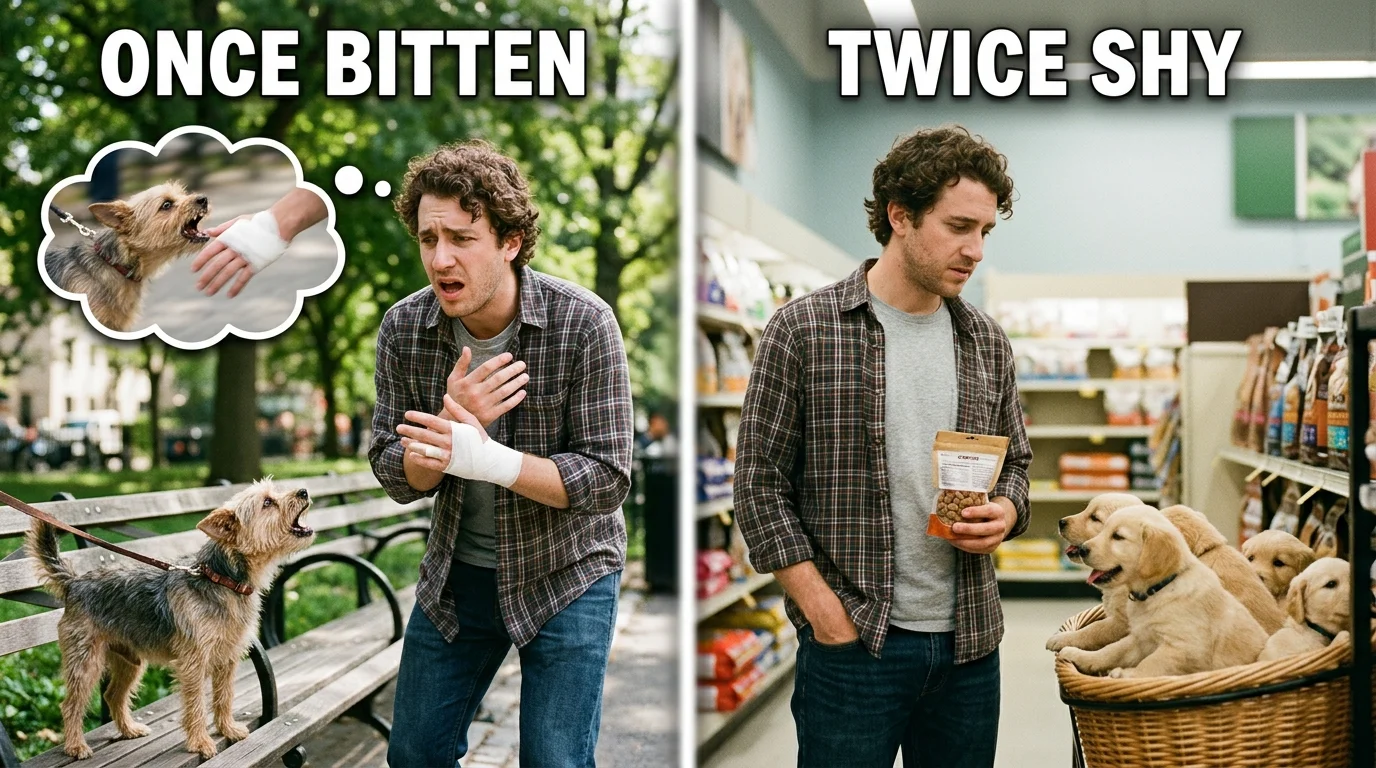
What Does Once Bitten Twice Shy Meaning?
Quick Definition
“Once bitten, twice shy” means a person who has had a bad experience is usually much more cautious about repeating it.
Literal Meaning
The phrase imagines someone being bitten once. After that painful experience, they’re naturally more careful to avoid being bitten again.
Figurative Meaning
In everyday English, it means learning from experience.
Someone who has:
- Been cheated.
- Lost money.
- Had their heart broken.
- Failed at something.
- Been disappointed.
may become more cautious the next time a similar situation arises.
What Tone Does It Convey?
The expression is generally:
- Wise
- Cautious
- Reflective
- Understanding
- Sometimes sympathetic
Origin and History of “Once Bitten, Twice Shy”
The proverb has been part of the English language for centuries.
Its origins are commonly linked to older sayings that emphasize learning from painful experiences. The modern version became widely used in English literature and everyday speech during the 19th century.
Over time, it has become a familiar expression used around the world to describe how people naturally become more careful after experiencing setbacks or harm.
How People Actually Use “Once Bitten, Twice Shy”
This proverb fits many real-life situations.
Relationships
Someone who has experienced betrayal or heartbreak may be reluctant to trust a new partner.
Example:
“After his last relationship ended badly, he’s once bitten, twice shy.”
Business
A company that loses money on a risky investment may avoid similar investments in the future.
Shopping
After buying a defective product, a customer may avoid purchasing from the same brand again.
Friendships
Someone who has been betrayed by a friend may take longer to trust new people.
Career
An employee who has had a poor experience at a workplace may carefully research future employers before accepting another job.
Real Examples of “Once Bitten, Twice Shy” in Conversations
Example 1
Person A: Why won’t you invest again?
Person B: I lost a lot of money last year. Once bitten, twice shy.
Meaning: A previous financial loss has made them more cautious.
Example 2
Person A: Why are you taking things so slowly in your new relationship?
Person B: I’ve been hurt before—once bitten, twice shy.
Meaning: Past emotional pain has made them more careful.
Example 3
Person A: Why don’t you order from that website anymore?
Person B: They sent me the wrong product twice. Once bitten, twice shy.
Meaning: A bad shopping experience influenced future decisions.
Example 4
Person A: Why are you reading every contract so carefully?
Person B: Once bitten, twice shy after my last business deal.
Meaning: Past mistakes have made them more cautious.
Example 5
Person A: Why are you nervous about changing jobs?
Person B: My previous employer treated me badly. Once bitten, twice shy.
Meaning: They’re being careful because of an earlier negative experience.
Common Mistakes and Misunderstandings
Mistake 1: Thinking It Only Refers to Physical Injuries
No. The “bite” is usually symbolic and refers to any unpleasant or painful experience.
Mistake 2: Assuming It Means Someone Is Afraid Forever
Not necessarily. It usually means they’re more cautious, not unwilling to try again.
Mistake 3: Using It Only for Romantic Relationships
The proverb applies to business, friendships, education, finances, shopping, and many other situations.
Mistake 4: Confusing Caution with Weakness
Being “twice shy” often reflects wisdom gained from experience rather than fear.
Similar Proverbs and Expressions
| Expression | Meaning | Difference |
|---|---|---|
| Once bitten, twice shy | Learn caution after a bad experience | Most direct equivalent |
| Learn from your mistakes | Improve based on experience | More general advice |
| Better safe than sorry | Be cautious to avoid problems | Preventive rather than reactive |
| Fool me once, shame on you; fool me twice, shame on me | Don’t allow repeated deception | Focuses on repeated trust |
| Burned before | Previously hurt or disappointed | Informal expression |
| Look before you leap | Think carefully before acting | Advice before taking action |
| Experience is the best teacher | Learning through real situations | Broader life lesson |
| A lesson learned | Knowledge gained from experience | General expression |
| Trust but verify | Be careful even when trusting others | Often used in business |
| Be on your guard | Stay alert to potential risks | Focuses on vigilance |
Is “Once Bitten, Twice Shy” Positive, Negative, or Neutral?
The proverb is generally neutral to positive.
It acknowledges that:
- Painful experiences happen.
- People naturally become more cautious.
- Learning from mistakes is often beneficial.
Although it refers to a negative event, its message is ultimately about wisdom and personal growth.
Related posts:
 Best Harakiri Meaning Definition, History, Cultural Significance & Modern Usage (2026)
 Best Concentration Meaning: Definition, Examples, Uses, and Types (2026)
 Best MPH Meaning Essential Definition, Full Form & Common Uses (2026)
 Best Coefficient Meaning: Definition, Formula, Examples & Uses in Math (2026)