
What Is a Variable in Math?
Quick Definition
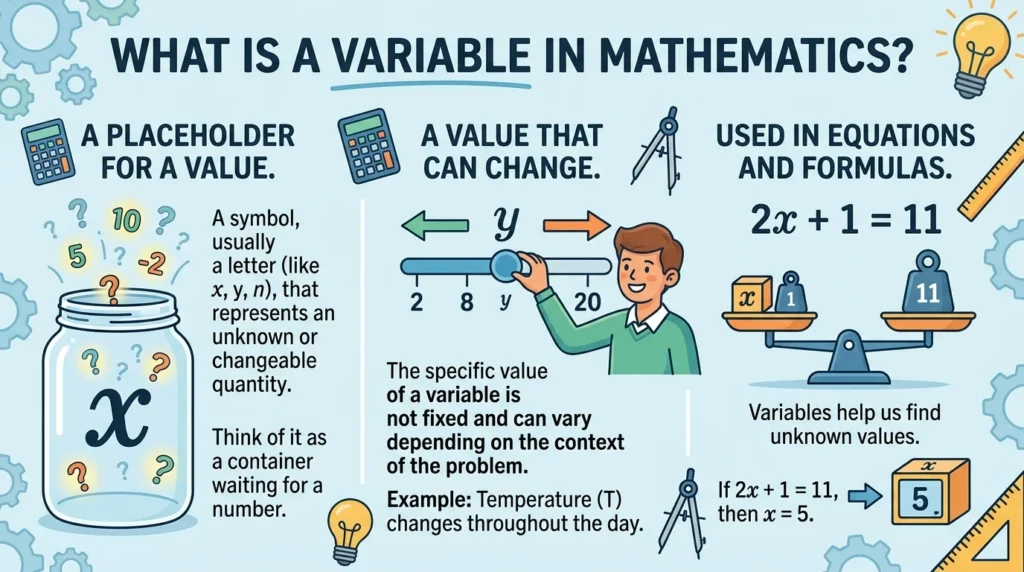
A variable is a symbol, usually a letter, that represents an unknown or changing numerical value.
Simple Explanation
Instead of writing a specific number, mathematicians use letters such as:
- x
- y
- z
- a
- b
- n
These letters stand for numbers that may be unknown or may change.
For example:
x + 4 = 10
Here, x is the variable. Its value is 6 because:
6 + 4 = 10
Why Are Variables Used?
Variables make math easier because they allow us to:
- Represent unknown numbers.
- Write formulas that work for many situations.
- Solve equations.
- Describe patterns.
- Express relationships between quantities.
Without variables, algebra and many branches of mathematics wouldn’t be possible.
Examples of Variables
Example 1
x + 3 = 8
Variable: x
Solution:
x = 5
Example 2
y = 4 × 6
Variable: y
Value:
y = 24
Example 3
A = l × w
Variables:
- A = Area
- l = Length
- w = Width
The variables can represent different numbers depending on the rectangle.
Example 4
n + 10
Here, n can be any number.
For example:
- n = 2 → 12
- n = 8 → 18
- n = 20 → 30
Types of Variables in Math
1. Independent Variable
An independent variable is the value you choose or control.
Example:
y = 2x + 1
Here, x is the independent variable.
2. Dependent Variable
A dependent variable changes based on another variable.
In:
y = 2x + 1
The value of y depends on x.
3. Unknown Variable
An unknown variable is a value you need to solve.
Example:
x − 7 = 5
Answer:
x = 12
4. Constant vs. Variable
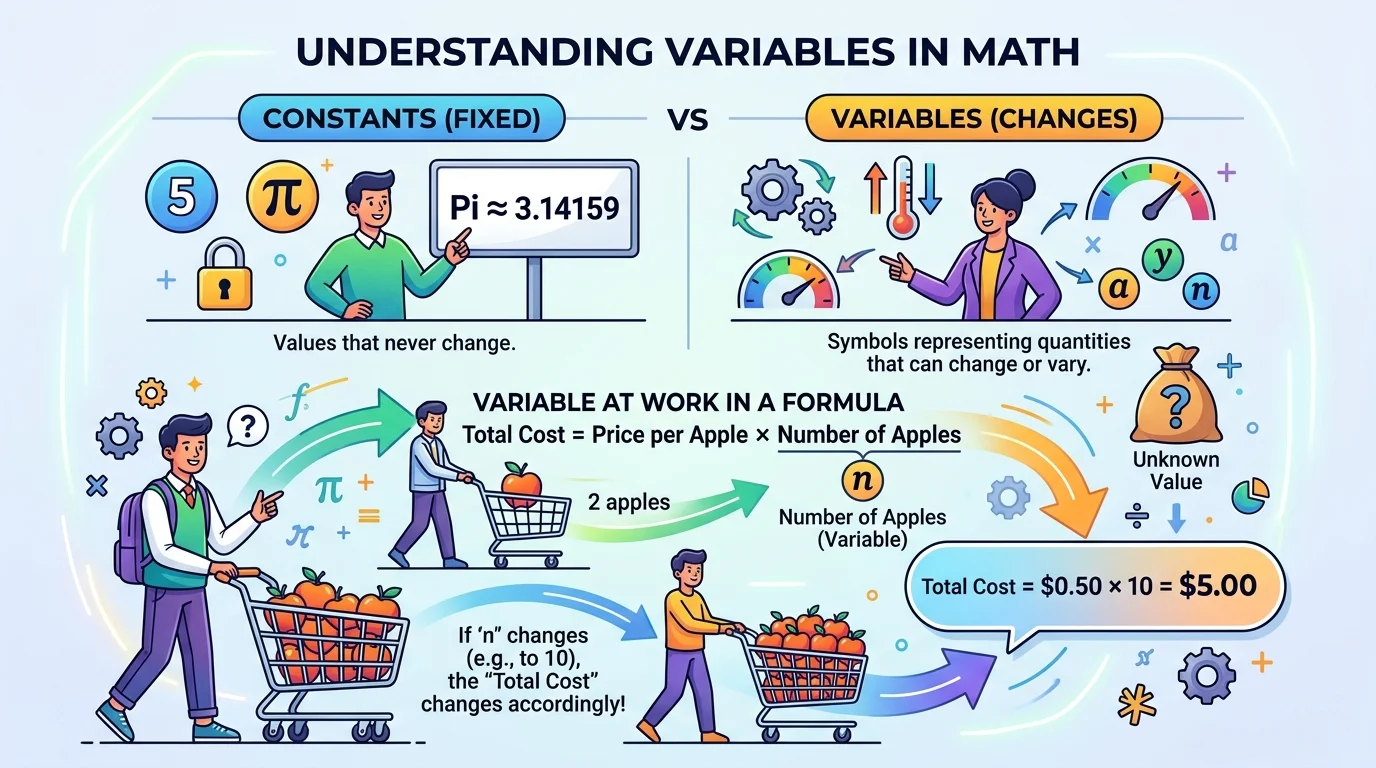
A constant always stays the same.
A variable can change.
Example:
5x + 2
- Variable: x
- Constants: 5 and 2
Variables in Algebra
Variables are the foundation of algebra.
Example:
2x + 5 = 17
Subtract 5:
2x = 12
Divide by 2:
x = 6
Here, the variable helps us solve the equation.
Variables in Formulas
Many mathematical formulas use variables.
Area of a Rectangle
Area = Length × Width
A = l × w
Distance Formula
Distance = Speed × Time
d = s × t
Circumference of a Circle
C = 2πr
Variables:
- C = Circumference
- r = Radius
Constant:
- π (Pi)
Real-Life Examples of Variables
Variables are used every day.
Shopping
Total Cost = Price × Quantity
If one item costs $8:
Total = 8 × n
Here, n is the number of items.
Travel
Distance = Speed × Time
If speed changes, distance changes too.
Temperature
Scientists often use variables to represent changing temperatures over time.
Finance
Interest, savings, and investments frequently use variables in formulas to calculate future values.
Common Mistakes and Misunderstandings
Mistake 1: Thinking Variables Are Always “x”
Variables can be any letter.
Examples include:
- a
- b
- c
- m
- n
- t
- y
Mistake 2: Believing Variables Always Have One Value
Sometimes they do.
Sometimes they can represent many possible values.
Example:
y = x + 2
If x changes, y changes too.
Mistake 3: Confusing Variables with Constants
A variable changes.
A constant remains fixed.
Mistake 4: Thinking Every Letter Is a Variable
Some letters represent constants.
For example:
π (pi) always has approximately the same value (3.14159).
Variable vs. Constant
| Term | Meaning | Example |
|---|---|---|
| Variable | A value that can change or is unknown | x, y, n |
| Constant | A value that stays the same | 5, 10, π |
Is a Variable Always Unknown?
No.
Sometimes a variable:
- Represents an unknown number.
- Represents different possible values.
- Represents measurements in formulas.
- Describes changing quantities in graphs.
Its role depends on the mathematical problem.
Related posts:
 Best Above Reproach Meaning: Definition, Examples, Origin & How to Use It Correctly (2026)
 Best Harakiri Meaning Definition, History, Cultural Significance & Modern Usage (2026)
 Best Callipygian Meaning: Definition, Origin, Examples & How to Use It Correctly (2026)
 Best Concentration Meaning: Definition, Examples, Uses, and Types (2026)