
What Does Protected Veteran Meaning?
Quick Definition
A protected veteran is a military veteran who belongs to a category protected by U.S. federal employment laws against discrimination.
These protections are intended to promote equal employment opportunities for eligible veterans.
What Does It Usually Mean?
If you’re a protected veteran, employers covered by federal law generally cannot discriminate against you because of your veteran status.
The term is primarily used in:
- Job applications
- Equal Employment Opportunity (EEO) forms
- Human resources documents
- Government contracting
What Tone Does It Convey?
The term is:
- Legal
- Employment-related
- Neutral
- Administrative
Who Qualifies as a Protected Veteran?
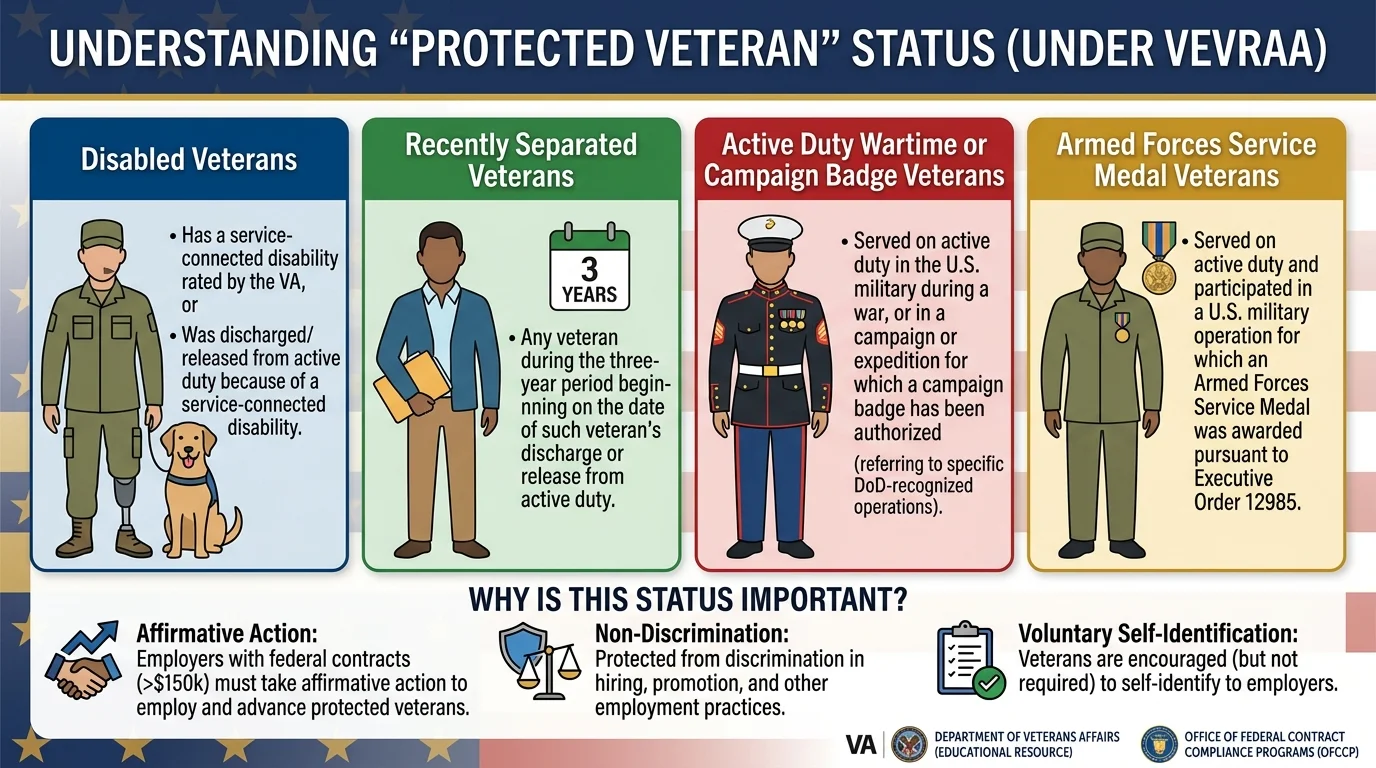
Under U.S. federal law, a protected veteran generally falls into one or more of these categories:
Disabled Veteran
A veteran who:
- Has a service-connected disability, or
- Was discharged because of a service-connected disability.
Recently Separated Veteran
A veteran who was discharged or released from active military service within the past three years.
Active Duty Wartime or Campaign Badge Veteran
A veteran who served on active duty during a war or in a military campaign for which a campaign badge was authorized.
Armed Forces Service Medal Veteran
A veteran who received an Armed Forces Service Medal for participating in a qualifying U.S. military operation.
Why Do Employers Ask if You’re a Protected Veteran?
Many employers—especially federal contractors—are required to collect veteran status information for compliance with U.S. equal employment opportunity laws.
The question helps employers:
- Monitor hiring practices.
- Ensure compliance with federal regulations.
- Promote equal employment opportunities.
- Report workforce demographics when required.
Importantly, answering this question is generally voluntary, and choosing not to answer typically does not affect your job application.
How People Actually Use the Term “Protected Veteran”
Most people encounter this term during the hiring process.
Job Applications
Example: “Are you a protected veteran?”
Meaning:
The employer is asking whether you qualify under one of the protected veteran categories recognized by U.S. law.
Human Resources
HR departments may ask employees to update their veteran status records for compliance and reporting purposes.
Government Contractors
Companies that work with the U.S. federal government often include protected veteran questions in their hiring paperwork because they’re required to follow specific employment regulations.
Real Examples of “Protected Veteran” in Conversations
Example 1
Person A: My job application asked if I’m a protected veteran.
Person B: They’re asking because of federal employment reporting requirements.
Meaning: The question helps employers comply with equal employment opportunity laws.
Example 2
Person A: I left the Army two years ago. Am I a protected veteran?
Person B: You may qualify as a recently separated veteran.
Meaning: Veterans discharged within the qualifying period may be protected.
Example 3
Person A: Will answering “yes” hurt my application?
Person B: No. Employers aren’t allowed to discriminate based on protected veteran status.
Meaning: The information is collected for legal compliance.
Example 4
Person A: I received a campaign badge during my military service.
Person B: You may qualify as a protected veteran.
Meaning: Certain campaign service qualifies under federal law.
Example 5
Person A: Do I have to answer the protected veteran question?
Person B: In many cases, it’s voluntary, and you can choose not to answer.
Meaning: Applicants are often allowed to decline without affecting their application.
Common Mistakes and Misunderstandings
Mistake 1: Thinking Every Veteran Is Automatically a Protected Veteran
Not necessarily. The legal definition applies to specific categories established under U.S. federal law.
Mistake 2: Believing Employers Ask to Reject Veterans
No. Employers generally ask for compliance with federal equal employment opportunity requirements, not to make hiring decisions.
Mistake 3: Assuming “Protected” Means Guaranteed Employment
Protected veteran status provides protection against discrimination—it does not guarantee a job.
Mistake 4: Confusing Protected Veteran Status with Disability Status
While some protected veterans are disabled veterans, not all protected veterans have a disability.
Related Employment Terms
| Term | Meaning | Difference |
|---|---|---|
| Protected Veteran | Veteran protected under U.S. employment law | Legal employment status |
| Veteran | Person who served in the military | Broader term |
| Disabled Veteran | Veteran with a service-connected disability | One category of protected veteran |
| Recently Separated Veteran | Veteran discharged within the qualifying period | Protected category |
| Equal Employment Opportunity (EEO) | Laws promoting fair hiring | Applies to many protected groups |
| Federal Contractor | Company doing business with the U.S. government | Often required to collect veteran data |
| Military Service | Service in the armed forces | General military experience |
| Service-Connected Disability | Disability related to military service | Medical/legal classification |
| Campaign Badge Veteran | Veteran awarded a campaign badge | Protected category |
| Armed Forces Service Medal Veteran | Veteran awarded a qualifying service medal | Protected category |
Is “Protected Veteran” Positive, Negative, or Neutral?
Protected veteran is a neutral legal term.
It does not indicate:
- Job performance.
- Military rank.
- Personal ability.
- Employment preference.
Instead, it identifies veterans who receive specific legal protections against workplace discrimination.
Related posts:
 Best Harakiri Meaning Definition, History, Cultural Significance & Modern Usage (2026)
 Best Concentration Meaning: Definition, Examples, Uses, and Types (2026)
 Best MPH Meaning: Definition, Uses, Examples & Multiple Meanings Explained (2026)
 Best Coefficient Meaning: Definition, Formula, Examples & Uses in Math (2026)