

What Does “Bible” Mean?
Quick Definition
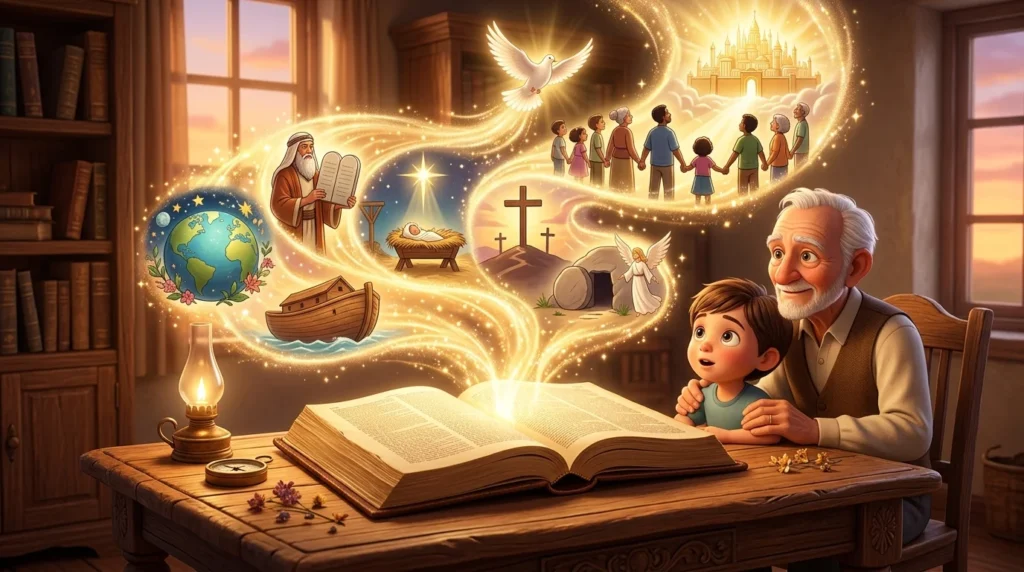
The Bible is the sacred scripture of Christianity and includes a collection of books that Christians believe communicate God’s message to humanity. The Hebrew Bible, also known as the Tanakh, is also sacred in Judaism.
Literal Meaning
The word Bible comes from the Greek word biblia (βιβλία), meaning “books” or “scrolls.” It reflects the fact that the Bible is a collection of many individual books rather than a single work.
What It Usually Means
Today, the term Bible commonly refers to:
- The holy book of Christianity.
- A collection of sacred scriptures.
- A source of spiritual guidance.
- A foundational text for Christian beliefs and practices.
In everyday English, “bible” can also be used metaphorically to describe an authoritative guide on a subject, such as “the photographer’s bible.”
Origin and History of the Bible
The Bible was written over many centuries by multiple authors in different historical settings.
The original texts were primarily written in:
- Hebrew
- Aramaic
- Greek
The books were later collected, translated, and preserved, becoming one of the most translated and widely distributed works in the world.
How Is the Bible Organized?
The Old Testament
The Old Testament includes writings that were composed before the life of Jesus and contains:
- Creation accounts.
- Historical narratives.
- Laws.
- Poetry and wisdom literature.
- Prophetic books.
The exact number of books varies among Christian traditions.
The New Testament
The New Testament focuses on:
- The life and teachings of Jesus Christ.
- The early Christian church.
- Letters written by early Christian leaders.
- The Book of Revelation.
Most Protestant Bibles contain 27 books in the New Testament.
Major Themes of the Bible
The Bible explores many central themes, including:
- Faith
- Love
- Hope
- Forgiveness
- Justice
- Mercy
- Redemption
- Obedience
- Wisdom
- Salvation
These themes appear throughout its various books and literary styles.
Why Is the Bible Important?
For many believers, the Bible serves as:
- A guide for daily living.
- A source of spiritual encouragement.
- A foundation for worship and prayer.
- A record of God’s relationship with humanity.
- A basis for Christian doctrine.
Beyond religion, the Bible has also influenced literature, art, music, law, and culture around the world.
How People Actually Use the Bible
People use the Bible in many ways, including:
- Reading daily devotionals.
- Studying religious teachings.
- Praying and reflecting.
- Worship services.
- Academic research.
- Historical and literary study.
Real Examples of “Bible” in Conversations
Example 1
Person A: What does the Bible mean?
Person B: It’s the sacred collection of scriptures central to Christianity.
Meaning: Basic definition.
Example 2
Person A: Why do people read the Bible every day?
Person B: Many read it for spiritual guidance and encouragement.
Meaning: Daily devotion.
Example 3
Person A: Is the Bible one book?
Person B: It’s actually a collection of many books written over centuries.
Meaning: Structure of the Bible.
Example 4
Person A: What language was the Bible written in?
Person B: Mainly Hebrew, Aramaic, and Greek.
Meaning: Original languages.
Example 5
Person A: What does “the photographer’s bible” mean?
Person B: It means an essential or authoritative guide on photography.
Meaning: Figurative use.
Example 6
Person A: Does every Bible have the same number of books?
Person B: No. Different Christian traditions include different numbers of books in their biblical canons.
Meaning: Canon differences.
Example 7
Person A: Can anyone study the Bible?
Person B: Yes. People read it for religious, historical, literary, or academic reasons.
Meaning: Broad use.
Example 8
Person A: Why is the Bible so influential?
Person B: It has shaped religion, culture, literature, and history for centuries.
Meaning: Global impact.
Common Mistakes and Misunderstandings
People sometimes assume:
- The Bible was written by one person.
- It is a single book.
- Every Christian tradition uses the exact same biblical canon.
In reality:
- It was written by many authors over centuries.
- It is a collection of books.
- Different Christian traditions recognize slightly different collections of books.
Similar Religious Texts
| Scripture | Religion | Description |
|---|---|---|
| Bible | Christianity | Sacred collection of books |
| Tanakh | Judaism | Hebrew Scriptures |
| Quran | Islam | Central sacred text of Islam |
| Bhagavad Gita | Hinduism | Hindu philosophical scripture |
| Torah | Judaism | First five books of the Hebrew Bible |
| Book of Mormon | Latter-day Saint movement | Additional sacred scripture in that tradition |
| Guru Granth Sahib | Sikhism | Central scripture of Sikhism |
| Tripitaka | Buddhism | Collection of Buddhist scriptures |
Is the Bible Positive, Negative, or Neutral?
The word Bible is generally considered positive or neutral, depending on the context. For believers, it is a sacred and authoritative text. In academic or historical discussions, it is often used as a neutral term referring to a significant religious document.
Should You Read the Bible?
You May Choose to Read It If You Want To
- Learn about Christianity.
- Study religious history.
- Explore moral and ethical teachings.
- Understand references in literature and culture.
- Deepen your personal faith.
Keep in Mind
The Bible contains many literary genres, including history, poetry, prophecy, parables, and letters. Different religious traditions may interpret certain passages differently.
Related posts:
 Best Harakiri Meaning Definition, History, Cultural Significance & Modern Usage (2026)
 Apocryphal Meaning: Definition, Origin, Examples & How to Use It (2026)
 Best Nine Line Meaning: Definition, Origin, Uses, Examples & What It Represents (2026)
 Optometrist Meaning Explained Complete Guide, Definition & Helpful Examples (2026)