

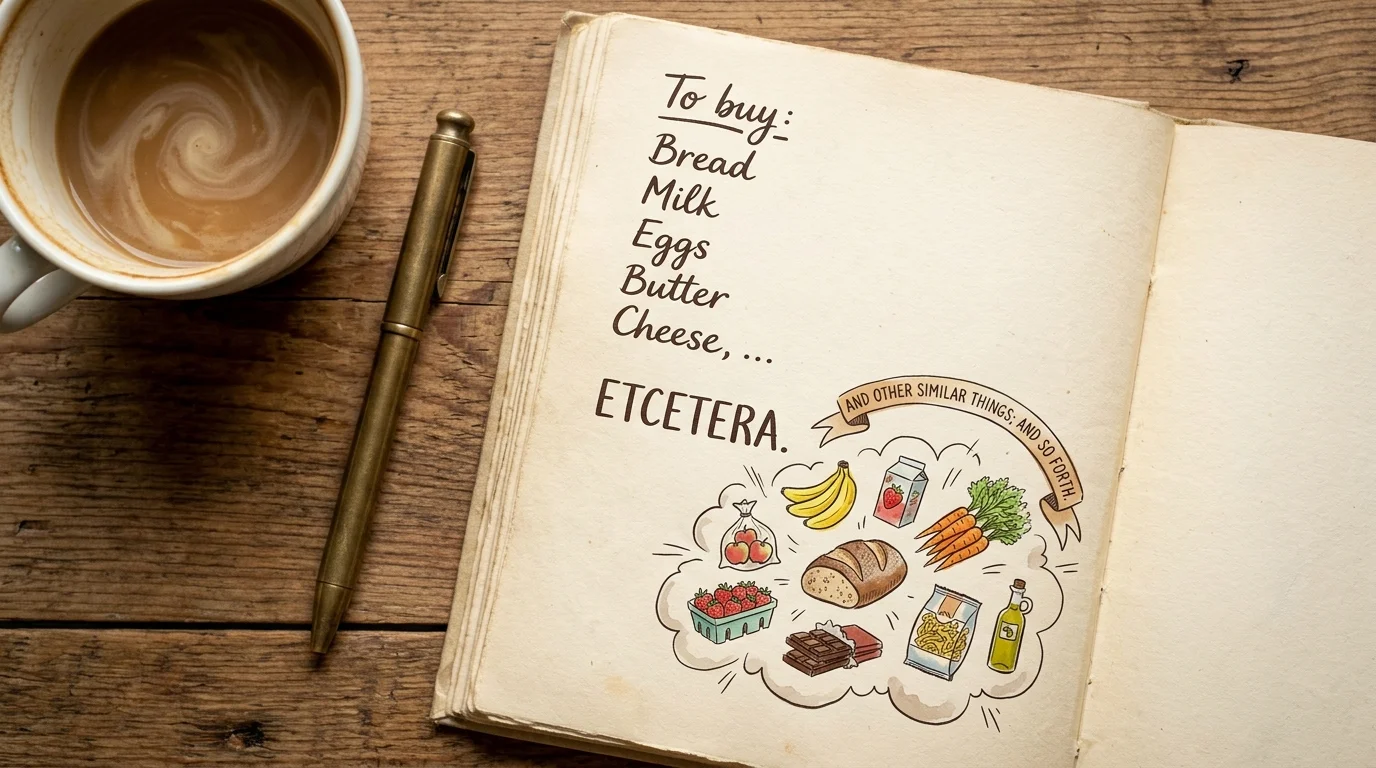
What Does Etcetera Meaning?
Quick Definition
Etcetera means “and other similar things,” “and so forth,” or “and the rest.”
What Does “Etc.” Stand For?
The abbreviation etc. stands for the full word etcetera.
It tells the reader that the list continues with similar items that don’t need to be written out.
What Tone Does It Convey?
Depending on the context, etcetera is generally:
- Neutral
- Informal to semi-formal
- Convenient for shortening lists
In highly formal or legal writing, it may be better to list all important items rather than use etc.
Origin and History of “Etcetera”
The word etcetera comes from the Latin phrase “et cetera,” which literally means “and the other things” or “and the rest.”
It combines:
- et = “and”
- cetera = “the remaining things”
The phrase entered English centuries ago and has become one of the most common Latin expressions still used today.
Although many people write it as one word (etcetera), the original Latin form is et cetera, and the abbreviation etc. is accepted in both British and American English.
How People Actually Use “Etcetera”
You’ll often see etc. used when the remaining items in a list are easy to understand.
Shopping Lists
“Buy apples, bananas, oranges, etc.”
Meaning: Buy those fruits and other similar fruits.
School Supplies
“You’ll need notebooks, pencils, markers, etc.”
Meaning: Bring those items and other related school supplies.
Daily Conversation
“We talked about work, family, vacations, etc.”
Meaning: Those topics and other similar subjects were discussed.
Business Writing
“The package includes installation, maintenance, support, etc.”
Meaning: Additional related services are included.
When Should You Use “Etc.”?
Use etc. when:
- The omitted items are obvious.
- You’re giving examples rather than a complete list.
- Listing every item would be unnecessary.
Good Examples
- Dogs, cats, rabbits, etc.
- Tables, chairs, sofas, etc.
- Reading, writing, math, etc.
In each case, the reader can easily understand what kinds of additional items are implied.
When Should You Avoid Using “Etc.”?
Avoid etc. when:
- The list needs to be complete.
- The omitted items are unclear.
- You’re writing legal, technical, or highly formal documents.
- The abbreviation creates confusion.
Instead, list every important item or use a more precise phrase if necessary.
Real Examples of “Etcetera” in Sentences
Example 1
“We packed clothes, shoes, toiletries, etc.”
Meaning: We packed those items and other travel essentials.
Example 2
“The restaurant serves burgers, sandwiches, salads, etc.”
Meaning: It offers those foods and similar menu items.
Example 3
“The meeting covered budgets, hiring, marketing, etc.”
Meaning: Several related business topics were discussed.
Example 4
“Students should bring pens, notebooks, calculators, etc.”
Meaning: They should bring those supplies and other necessary classroom materials.
Example 5
“He enjoys hiking, camping, fishing, etc.”
Meaning: He enjoys those outdoor activities and similar hobbies.
Common Mistakes and Misunderstandings
Mistake 1: Writing “and etc.”
This is incorrect because etc. already means “and the rest.”
❌ Apples, oranges, and etc.
✅ Apples, oranges, etc.
Mistake 2: Using “Etc.” After “For Example”
Phrases like “for example” or “such as” already introduce examples. While etc. isn’t always grammatically wrong after them, it can often be unnecessary or repetitive.
Mistake 3: Using “Etc.” When the List Isn’t Clear
Avoid:
“We discussed important things, etc.”
The reader doesn’t know what “important things” includes.
Mistake 4: Overusing “Etc.”
Using etc. too frequently can make your writing vague. Sometimes it’s better to provide a few more examples or complete the list.
Similar Words and Expressions
| Expression | Meaning | Difference |
|---|---|---|
| Etc. | And other similar things | Most common abbreviation |
| And so on | Additional similar items | More conversational |
| And so forth | Continuing in the same way | Slightly more formal |
| Among others | Including additional examples | Often used for people or groups |
| Such as | Introduces examples | Doesn’t imply a complete list |
| Including | Adds examples | More specific than etc. |
| Namely | Specifically | Introduces a complete list |
| For example | Gives examples | Doesn’t mean “and the rest” |
| Including but not limited to | Additional unspecified items | Common in legal writing |
| And the like | Similar things | Less common in modern English |
Is “Etcetera” Formal or Informal?
Etcetera is generally acceptable in:
- Everyday writing
- Emails
- Notes
- Articles
- Educational materials
In very formal writing, legal contracts, or technical documents, it’s often better to list all relevant items instead of using etc.
Related posts:
 Best Above Reproach Meaning: Definition, Examples, Origin & How to Use It Correctly (2026)
 Best Harakiri Meaning Definition, History, Cultural Significance & Modern Usage (2026)
 Best Callipygian Meaning: Definition, Origin, Examples & How to Use It Correctly (2026)
 Best Concentration Meaning: Definition, Examples, Uses, and Types (2026)